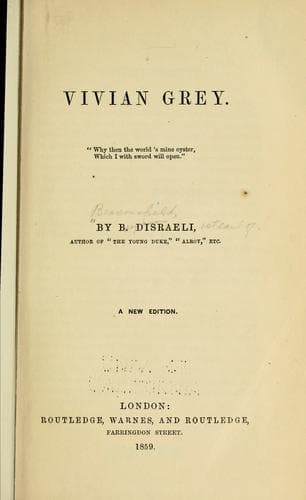
Vivian GreyDisraeli, Benjamin, Earl of Beaconsfield
ReligionIslamic
Vivian Grey
Disraeli, Benjamin, Earl of Beaconsfield
Bildungsromans; British -- Europe -- Fiction; Political fiction; Politicians -- Fiction; Young men -- Fiction
“Do you think so?” said Vivian; “I once thought so myself, but I confess
that my opinion is greatly changed. After all, what is noble blood? My
eye is now resting on a crowd of nobles; and yet, being among them, do
we treat them in a manner differing in any way from that which we should
employ to individuals of a lower caste who were equally uninteresting?”
“Certainly not,” said Mrs. Million.
“The height of the ambition of the less exalted ranks is to be noble,
because they conceive to be noble implies to be superior; associating in
their minds, as they always do, a pre-eminence over their equals. But to
be noble among nobles, where is the pre-eminence?”
“Where indeed?” said Mrs. Million; and she thought of herself, sitting
the most considered personage in this grand castle, and yet with
sufficiently base blood flowing in her veins.
“And thus, in the highest circles,” continued Vivian, “a man is of
course not valued because he is a Marquess or a Duke; but because he is
a great warrior, or a great statesman, or very fashionable, or very
witty. In all classes but the highest, a peer, however unbefriended by
nature or by fortune, becomes a man of a certain rate of consequence;
but to be a person of consequence in the highest class requires
something else besides high blood.”
“I quite agree with you in your sentiments, Mr. Grey. Now what
character or what situation in life would you choose, if you had the
power of making your choice?”
“That is really a most metaphysical question. As is the custom of all
young men, I have sometimes, in my reveries, imagined what I conceived
to be a lot of pure happiness: and yet Mrs. Million will perhaps be
astonished that I was neither to be nobly born nor to acquire nobility,
that I was not to be a statesman, or a poet, or a warrior, or a
merchant, nor indeed any profession, not even a professional dandy.”
“Oh! love in a cottage, I suppose,” interrupted Mrs. Million.
“Neither love in a cottage, nor science in a cell.”
“Oh! pray tell me what it is.”
“What it is? Oh! Lord Mayor of London, I suppose; that is the only
situation which answers to my oracular description.”
“Then you have been joking all this time!”
“Not at all. Come then, let us imagine this perfect lot. In the first
place, I would be born in the middle classes of society, or even lower,
because I would wish my character to be impartially developed. I would
be born to no hereditary prejudices, no hereditary passions. My course
in life should not be carved out by the example of a grandfather, nor my
ideas modelled to a preconceived system of family perfection. Do you
like my first principle, Mrs. Million?”
“I must hear everything before I give an opinion.”
“When, therefore, my mind was formed, I would wish to become the
proprietor of a princely fortune.”
“Yes!” eagerly exclaimed Mrs. Million.
Public-domain text, read in full here on John Shaqi.
Reviews
Reviews
No reviews yet
Be the first to share your thoughts on this work.
Join the Discussion
Join the discussion
Sign in to leave a comment or review.
Sign InorCreate an account