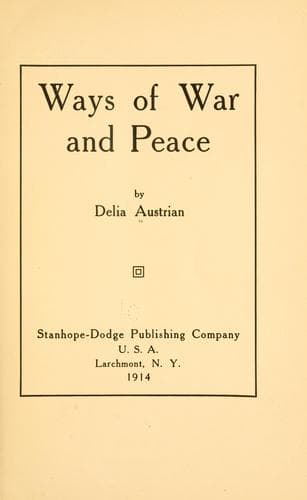
Peace; World War, 1914-1918 -- Personal narratives
If "war is hell," then to be in a strange country without credit and
funds is certainly purgatory. If you do not believe this to be true, ask
any of your friends who happened to be in the war zone and they will
certainly corroborate my story.
Though I was grief-stricken by the news that the great powers of Europe
had decided to wage a world-war, I knew that this feeling was
intensified when the banks of Germany refused to recognize any foreign
letters of credit.
I should not have had a dollar to my name had my mother been well, but
as she was quite sick I went to the bank twice that week, for I thought
if she were worse later I could not leave her. We had just paid a week's
board-bill and I vowed that we should not pay another until the banks
gave us more money. I was so angry when I saw another week sneak round
and another bill appear, that I left it unopened on my bureau for a
week.
Before long I realized that being angry would do no good. I must hustle
and get some credit. The first few days it was hopeless, for there was
a perfect run on the two small banks in our town; sometimes there were
several hundred people waiting at the doors for them to open. Most of
these were Russians and Poles trying to get the money out of the banks
and to hurry home before it was too late.
One day I worked my way through the crowd and got to the cashier's desk,
where I was refused. The clerk said that he would give me change, but
since England had made war it was foolish to take their checks, as it
might be months before he could cash them. I saw it was foolish to argue
the point, but I was furious, as up to this time he had been so
solicitous about our having enough money.
The clerks at the other bank were even more disagreeable. They were all
right to the Germans, but they treated Americans as a lot of dead-beats,
who were more accustomed to travel on credit.
But I was comforted by the fact that though there were plenty of wealthy
men in our sanitarium, they were all in the same box. There were a
half-dozen millionaires whose united fortunes represented at least fifty
million dollars, but they could not raise five hundred dollars on it.
They said little, but the seriousness of their faces showed they thought
much. If they ever knew what poverty meant it was so many years ago
that they had forgotten all about its sting. These tight circumstances
did not bring out the soft, kind side of their nature, it seemed to make
them skeptics instead. They were silent and taciturn, and acted as
though a short conversation indicated a "financial touch."
One of our multi-millionaires, who poses as a splendid church-worker,
never let his acquaintanceship extend beyond a nod or a "how do you do,"
as though he thought a warmer friendship meant financial aid.
He was traveling with a friend who had less in fortune, but more heart.
His friend promised to look after mother and me, but somehow the
philanthropist put a damper on the promise.
Public-domain text, read in full here on John Shaqi.
Reviews
Reviews
No reviews yet
Be the first to share your thoughts on this work.
Join the Discussion
Join the discussion
Sign in to leave a comment or review.
Sign InorCreate an account