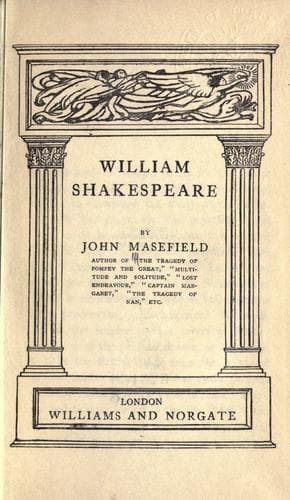
Shakespeare, William, 1564-1616 -- Criticism and interpretation
The Greek tragic poets ended the action of their plays in the modern
manner, at the great scene, but, unlike us, they delayed the departure
of the audience for some minutes more, generally by a chorus of men and
women who expounded the moral value of the action in noble verse. The
audience came away calmed. If a Greek had constructed _Julius Caesar_, he
would have ended the action at the murder. A chorus of senators would
then have chanted something noble about the results of pride, the vanity
of human glory, and the strangeness of the ways of the gods. A modern
writer would have caused the curtain to fall at the murder, for to-day,
when the brains are out the play dies and there an end. Shakespeare
carries on his play for two acts after Caesar is dead. In _Macbeth_ he
constructs the last half of his play in much the same manner.
In both plays he is considering the conception, the doing, and the
results of a violent act. In both plays this act is the murder of the
head of a State. In neither case is he deeply interested in the victim.
Duncan, in _Macbeth_, is a generous gentleman; Caesar, in this play, is a
touchy man of affairs whose head is turned. Shakespeare's imagination
broods on the fact that the killers were deluded into murder, Macbeth by
an envious wife and the belief that Fate meant him to be king, Brutus by
an envious friend and the belief that he was saving Rome. In both cases
the killers show base personal ingratitude and treachery. In both plays,
an avenging justice makes even the scales. The mind of the poet follows
them from the moment when the guilty thought is prompted, through the
agony and exultation of dreadful acts, to the unhappiness that dogs the
treacherous, till Fate's just sword falls in vengeance. His imagination
is most keenly stirred just as ours is, by the great event, the murder
of the victim: but his subject is not the murder, nor yet the tragical
end of a ruler. His subject in both plays is the working of Fate who
prompts to murder, uses the murderer, and then destroys him. We are
interested in crisis and in topic. The Elizabethans, with a wider
vision, could not detach an act from its place in the pageant of
history. In a modern play the heroine is put into an unpleasant
position, or an evil is exposed, or our faults are made visible and
laughable. The point of view is that of the sympathiser, reformer, and
moralist looking on from the window near by. The field of vision is
restricted and the object brought near. In this great play, as in
_Macbeth_, Shakespeare strove to present a violent act and its
consequences from the point of view of a great just spirit outside life.
Public-domain text, read in full here on John Shaqi.
Reviews
Reviews
No reviews yet
Be the first to share your thoughts on this work.
Join the Discussion
Join the discussion
Sign in to leave a comment or review.
Sign InorCreate an account