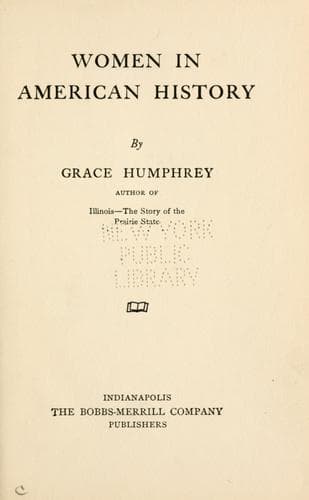
Women -- Biography; Women -- United States -- Biography
In vain she pleaded. He was firm. “We have spies enough here. How do
I know but the British have sent you to burn what they have left? You
will not cross the river, that is sure.”
“But I am Mrs. Madison, the wife of your president,” she answered,
throwing off her disguise. Then he rowed her across the Potomac.
Through clouds of smoke, past heaps of still smoldering ruins, she made
her way to the home of her sister, and waited there for Mr. Madison to
return.
While the White House was being rebuilt the Madisons lived in
Pennsylvania Avenue, and a brilliant social life centered about them.
They revived the levees of Washington and Adams, gave handsome state
dinners and introduced music at their receptions.
When Madison’s second term was ended they went to live at Montpelier,
their beautiful Virginia home, where they entertained with true
southern hospitality the many friends and tourists who visited them.
Mr. Madison, for many years an invalid, busied himself with books and
writing.
Soon after his death in 1836 Dolly returned to Washington, to be near
her old friends. Her home again became a social center, for her tact
and beauty and grace made her always a favorite and a leader. She
entertained many distinguished guests, “looking every inch a queen,”
the British ambassador declared. Sometimes there were as many visitors
at her receptions as at those at the White House. All the homage of
former times was hers, and much consideration was shown her by public
officials, Congress voting her a seat on the floor of the House.
Brought up in strict Quaker ways, she adorned every station in life
in which she was placed. And in a crisis when the White House was in
danger, Dolly Madison was courageous enough to delay her departure
till she had saved the Stuart Washington and the Declaration of
Independence.
CHAPTER X
LUCRETIA MOTT
1793-1880
Lucretia Coffin was a Quaker, born on the quaint little island of
Nantucket. Her father “followed the sea,” captain of a whaler, and
was often gone for long periods of time. So it was the mother who was
responsible for the early training of the six children. Thrift and
efficient housekeeping Lucretia learned, along with the Quaker doctrine
of non-resistance, and a thorough knowledge of the Bible.
When she was twelve, Captain Coffin forsook the sea and moved his
family to Boston. Public schools there gave Lucretia a feeling of
sympathy for the patient struggling poor which was always a prominent
trait in her character.
Public-domain text, read in full here on John Shaqi.
Reviews
Reviews
No reviews yet
Be the first to share your thoughts on this work.
Join the Discussion
Join the discussion
Sign in to leave a comment or review.
Sign InorCreate an account