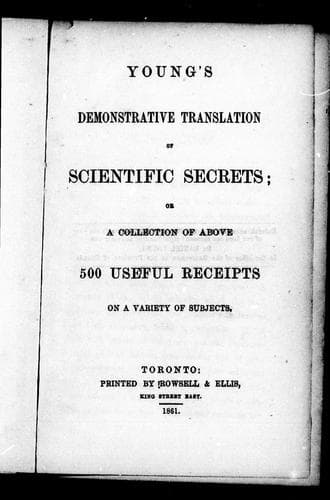
Young's Demonstrative Translation of Scientific Secrets: Or, A Collection of Above 500 Useful Receipts on a Variety of Subjects — John Shaqi
Young's Demonstrative Translation of Scientific Secrets: Or, A Collection of Above 500 Useful Receipts on a Variety of SubjectsYoung, Daniel
Science
Young's Demonstrative Translation of Scientific Secrets: Or, A Collection of Above 500 Useful Receipts on a Variety of Subjects
Young, Daniel
Formulas, recipes, etc.; Science -- Methodology
The colours thus prepared after having been rubbed up on a plate of
ground glass with the spirits of turpentine or lavender, thickened
in the air are applied with a hair pencil. Before using them,
however, it is necessary to try them on small pieces of glass, and
expose them to the fire, to ascertain if the desired tone of colour
is produced. The artist must be guided by these proof pieces in
using his colours. The proper glass for receiving these colours
should be uniform, colourless, and difficult of fusion. For this
reason crown glass made with a little alkali or kelp is preferred.
A design must be drawn upon paper and placed beneath the plate of
glass. The upper side of the glass being sponged over with gum-water
affords, when dry, a surface proper for receiving the colours,
without the risk of their running irregularly, as they would be apt
to do on the slippery glass. The artist draws on the plate, with a
fine pencil all the traces which mark the great outlines and shades
of the figures. This is usually done in black, and afterwards, when
it is dry, the vitrifying colours are laid on by means of larger
hair pencils. The yellow formed with chloride of silver is generally
laid on the back of the glass, for it is apt to run with the other
colours while heating.
The pigments used in painting on glass are principally matallic
oxides and chlorides, and as, in most of these, the colour is not
brought out until after the painting is submitted to heat, it is
necessary to ascertain beforehand if the colours are properly mixed
by painting on slips of glass, and exposing them to heat in a
muffle. The painter is guided by these trial pieces in laying on his
colours. To fire the paintings a furnace with a muffle is used. The
muffles are made of refractory clay.
257. WHITE COATING FOR GOLD VARNISHES
A quart of strong parchment size and half a pint of water are to be
made quite hot, and to these are to be added, (in small portions
from time to time,) two good handsful of common whiting, passed
through a fine sieve; this mixture is to be left to infuse for half
an hour, when it is to be stirred carefully so that the amalgamation
may be perfect. This coating is preferable to any glue or cement for
coating picture frames, &c., on which is to be laid the tin or
silver leaf, to be varnished with gold varnishes or lackers.
258. LEAD COLOURING PAINT
Whiting, 112 lbs...................... $1.12
Blue-black, 5 lbs..................... 0.25
White lead ground in oil, 28 lbs...... 2.24
Road-dirt, 56 lbs..................... 0.10
Lime-water, 5 galls................... 0.05
Residue of the oil, 2-1/4 galls....... 1.25
--------
Weights, 256 lbs....... $5.01
Public-domain text, read in full here on John Shaqi.
Reviews
Reviews
No reviews yet
Be the first to share your thoughts on this work.
Join the Discussion
Join the discussion
Sign in to leave a comment or review.
Sign InorCreate an account