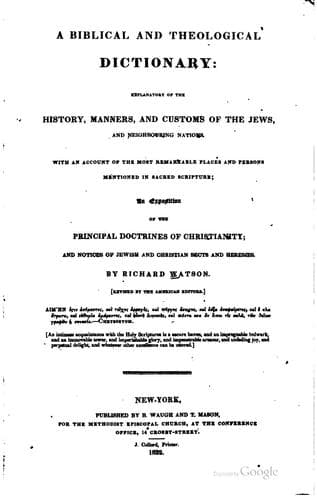
A Biblical and Theological Dictionary: explanatory of the history, manners, and customs of the Jews, and neighbouring nationsWatson, Richard
Religion
A Biblical and Theological Dictionary: explanatory of the history, manners, and customs of the Jews, and neighbouring nations
Watson, Richard
Bible -- Dictionaries; Theology -- Dictionaries
The “_knowledge_” in which the Apostle Paul, in the passage quoted above
from Colossians iii, 10, places “the image of God” after which man was
created, does not merely imply the faculty of understanding, which is a
part of the _natural_ image of God; but that which might be lost,
because it is that in which we may be “_renewed_.” It is, therefore, to
be understood of the faculty of knowledge in right exercise; and of that
willing reception, and firm retaining, and hearty approval, of religious
truth, in which knowledge, when spoken of morally, is always understood
in the Scriptures. We may not be disposed to allow, with some, that Adam
understood the deep philosophy of nature, and could comprehend and
explain the sublime mysteries of religion. The circumstance of his
giving names to the animals, is certainly no sufficient proof of his
having attained to a philosophical acquaintance with their qualities and
distinguishing habits, although we should allow their names to be still
retained in the Hebrew, and to be as expressive of their peculiarities
as some expositors have stated. Sufficient time appears not to have been
afforded him for the study of the properties of animals, as this event
took place previous to the formation of Eve; and as for the notion of
his acquiring knowledge by intuition, this is contradicted by the
_revealed_ fact, that angels themselves acquire their knowledge by
observation and study, though no doubt, with great rapidity and
certainty. The whole of this transaction was supernatural; the beasts
were “brought” to Adam, and it is probable that he named them under a
Divine suggestion. He has been also supposed to be the inventor of
language, but his history shows that he was never without speech. From
the first he was able to converse with God; and we may, therefore, infer
that language was in him a supernatural and miraculous endowment. That
his understanding was, as to its capacity, deep and large beyond any of
his posterity, must follow from the perfection in which he was created;
and his acquisitions of knowledge would, therefore, be rapid and easy.
It was, however, in moral and religious truth, as being of the first
concern to him, that we are to suppose the excellency of his knowledge
to have consisted. “His reason would be clear, his judgment uncorrupted,
and his conscience upright and sensible.” The best knowledge would, in
him, be placed first, and that of every other kind be made subservient
to it, according to its relation to that. The Apostle adds to knowledge,
“righteousness and true holiness;” terms which express, not merely
freedom from sin, but positive and active virtue.
Public-domain text, read in full here on John Shaqi.
Reviews
Reviews
No reviews yet
Be the first to share your thoughts on this work.
Join the Discussion
Join the discussion
Sign in to leave a comment or review.
Sign InorCreate an account