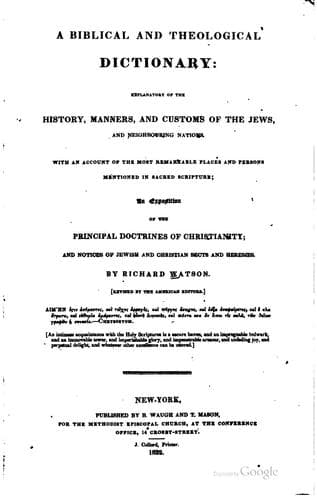
A Biblical and Theological Dictionary: explanatory of the history, manners, and customs of the Jews, and neighbouring nations — John Shaqi
A Biblical and Theological Dictionary: explanatory of the history, manners, and customs of the Jews, and neighbouring nationsWatson, Richard
Religion
A Biblical and Theological Dictionary: explanatory of the history, manners, and customs of the Jews, and neighbouring nations
Watson, Richard
Bible -- Dictionaries; Theology -- Dictionaries
On the degree of moral excellence also in the first man, much license
has been given to a warm imagination, and to rhetorical embellishment;
and Adam’s perfection has sometimes been fixed at an elevation which
renders it exceedingly difficult to conceive how he could fall into sin
at all. On the other hand, those who either deny or hold very slightly
the doctrine of our hereditary depravity, delight to represent Adam as
little superior in moral perfection and capability to his descendants.
But, if we attend to the passages of holy writ above quoted, we shall be
able, on this subject, to ascertain, if not the exact degree of his
moral endowments, yet that there is a certain standard below which they
cannot be placed.--Generally, he was made in the _image_ of God, which,
we have already proved, is to be understood _morally_ as well as
_naturally_. Now, however the image of any thing may be limited in
extent, it must still be an accurate representation as far as it goes.
Every thing good in the creation must always be a miniature
representation of the excellence of the Creator; but, in this case, the
“goodness,” that is, the perfection, of every creature, according to the
part it was designed to act in the general assemblage of beings
collected into our system, wholly forbids us to suppose that the image
of God’s moral perfections in man was a blurred and dim representation.
To whatever _extent_ it went, it necessarily excluded all that from man
which did not resemble God; it was a likeness to God in “righteousness
and true holiness,” whatever the degree of each might be, and excluded
all admixture of unrighteousness and unholiness. Man, therefore, in his
original state, was _sinless_, both in act and in principle. Hence it is
said that “God made man UPRIGHT.” That this signifies moral rectitude
cannot be doubted; but the import of the word is very extensive. It
expresses, by an easy figure, the _exactness_ of truth, justice, and
obedience; and it comprehends the state and habit both of the heart and
the life. Such, then, was the condition of primitive man; there was no
obliquity in his moral principles, his mind, or affections; none in his
conduct. He was perfectly sincere and exactly just, rendering from the
heart all that was due to God and to the creature. Tried by the exactest
_plummet_, he was _upright_; by the most perfect rule, he was
_straight_.
Public-domain text, read in full here on John Shaqi.
Reviews
Reviews
No reviews yet
Be the first to share your thoughts on this work.
Join the Discussion
Join the discussion
Sign in to leave a comment or review.
Sign InorCreate an account