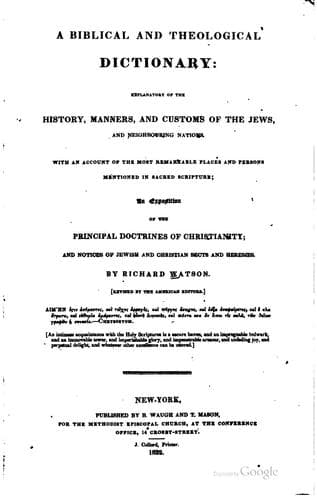
A Biblical and Theological Dictionary: explanatory of the history, manners, and customs of the Jews, and neighbouring nationsWatson, Richard
Religion
A Biblical and Theological Dictionary: explanatory of the history, manners, and customs of the Jews, and neighbouring nations
Watson, Richard
Bible -- Dictionaries; Theology -- Dictionaries
7. That Adam was a type of Christ, is plainly affirmed by St. Paul, who
calls him “the figure of him who was to come.” Hence our Lord is
sometimes called, not inaptly, the Second Adam. This typical relation
stands sometimes in SIMILITUDE, sometimes in CONTRAST. Adam was formed
immediately by God, as was the humanity of Christ. In each the nature
was spotless, and richly endowed with knowledge and true holiness. Both
are seen invested with dominion over the earth and all its creatures;
and this may explain the eighth Psalm, where David seems to make the
sovereignty of the first man over the whole earth in its pristine glory,
the prophetic symbol of the dominion of Christ over the world restored.
Beyond these particulars fancy must not carry us; and the typical
CONTRAST must also be limited to that which is stated in Scripture, or
supported by its allusions. Adam and Christ were each a public person, a
_federal head_ to the whole race of mankind; but the one was the
fountain of sin and death, the other of righteousness and life. By
Adam’s transgression “many were made sinners,” Rom. v, 14–19. Through
him, “death passed upon all men, because all have sinned” in him. But he
thus prefigured that one man, by whose righteousness the “free gift
comes upon all men to justification of life.” The first man communicated
a living soul to all his posterity; the other is a quickening Spirit, to
restore them to newness of life now, and to raise them up at the last
day. By the imputation of the first Adam’s sin, and the communication of
his fallen, depraved nature, death reigned over those who had not sinned
after the similitude of Adam’s transgression; and through the
righteousness of the Second Adam, and the communication of a divine
nature by the Holy Spirit, favour and grace shall much more abound in
Christ’s true followers unto eternal life. See REDEMPTION.
ADAMA, one of the five cities which were destroyed by fire from heaven,
and buried under the waters of the Dead Sea, Gen. xiv, 2; Deut. xxix,
23. It was the most easterly of all those which were swallowed up; and
there is some probability that it was not entirely sunk under the
waters; or that the inhabitants of the country built a new city of the
same name upon the eastern shore of the Dead Sea: for Isaiah, according
to the Septuagint, says, “God will destroy the Moabites, the city of Ar,
and the remnant of Adama.”
Public-domain text, read in full here on John Shaqi.
Reviews
Reviews
No reviews yet
Be the first to share your thoughts on this work.
Join the Discussion
Join the discussion
Sign in to leave a comment or review.
Sign InorCreate an account