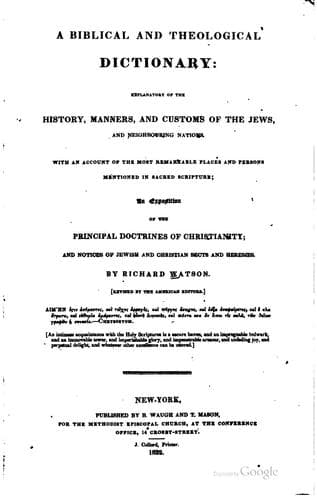
A Biblical and Theological Dictionary: explanatory of the history, manners, and customs of the Jews, and neighbouring nationsWatson, Richard
Religion
A Biblical and Theological Dictionary: explanatory of the history, manners, and customs of the Jews, and neighbouring nations
Watson, Richard
Bible -- Dictionaries; Theology -- Dictionaries
head through the high grass, and began to creep after the musician,
stopping when he stopped, and beginning to follow him again, as soon as
he moved forward. In this manner he was led out of their camp, attended
by a great number of spectators, both savages and Europeans, who could
scarcely believe their eyes, when they beheld this wonderful effect of
harmony. The assembly unanimously decreed, that the serpent which had so
highly entertained them, should be permitted to escape. Many of them are
carried in baskets through Hindostan, and procure a maintenance for a
set of people who play a few simple notes on the flute, with which the
snakes seem much delighted, and keep time by a graceful motion of the
head, erecting about half their length from the ground, and following
the music with gentle curves, like the undulating lines of a swan’s
neck.
But on some serpents, these charms seem to have no power; and it appears
from Scripture, that the adder sometimes takes precautions to prevent
the fascination which he sees preparing for him: “for the deaf adder
shutteth her ear, and will not hear the voice of the most skilful
charmer.” The threatening of the Prophet Jeremiah proceeds upon the same
fact: “I will send serpents” (cockatrices) “among you, which will not be
charmed, and they shall bite you.” In all these quotations, the sacred
writers, while they take it for granted that many serpents are disarmed
by charming, plainly admit that the powers of the charmer are in vain
exerted upon others.
It is the opinion of some interpreters, that the word שחל, which in some
parts of Scripture denotes a lion, in others means an adder, or some
other kind of serpent. Thus, in the ninety-first Psalm, they render it
the basilisk: “Thou shalt tread upon the adder and the basilisk, the
young lion and the dragon thou shalt trample under foot.” Indeed, all
the ancient expositors agree, that some species of serpent is meant,
although they cannot determine what particular serpent the sacred writer
had in view. The learned Bochart thinks it extremely probable that the
holy Psalmist in this verse treats of serpents only; and, by
consequence, that both the terms שחל and כפיר mean some kind of snakes,
as well as פתן and תנין; because the coherence of the verse is by this
view better preserved, than by mingling lions and serpents together, as
our translators and other interpreters have commonly done; nor is it
easy to imagine what can be meant by treading upon the lion, and
trampling the young lion under foot; for it is not possible in walking
to tread upon the lion, as upon the adder, the basilisk, and other
serpents.
To ADJURE, to bind by oath, as under the penalty of a fearful curse,
Joshua vi, 26; Mark v, 7. 2. To charge solemnly, as by the authority,
and under pain, of the displeasure of God, Matt. xxvi, 63; Acts xix, 13.
Public-domain text, read in full here on John Shaqi.
Reviews
Reviews
No reviews yet
Be the first to share your thoughts on this work.
Elsewhere in the archive
Join the Discussion
Join the discussion
Sign in to leave a comment or review.
Sign InorCreate an account