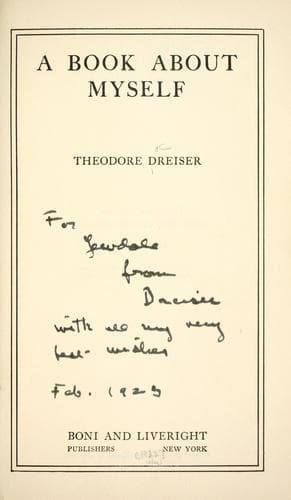
Dreiser, Theodore, 1871-1945; Journalists -- United States -- Biography; Novelists, American -- 20th century -- Biography
“Upon my word,” I once heard him exclaim, as he read one of my daily
effusions. “The rascals. Who would think that such scamps would be
allowed to run at large in a city like this! They certainly ought to be
in jail. Every one of them. And the police along with them.” Then he
chuckled, slapped his knee and finally came over and made some inquiries
in regard to a certain dealer whom I had chanced to picture. I was
cautioned against overstating anything; also against detection and being
beaten up by those whom I was offending. For I noticed after the first
day or two that the barkers of some of the shops occasionally studied me
curiously or ceased their more shameful effronteries in my presence and
produced something of more value. The facts which my articles presented,
however, finally began to attract a little attention to the paper.
Either because the paper sold better or because this was an excellent
club wherewith to belabor his enemies, the publisher now decided to call
the attention of the public via the billboards, to what was going on in
our columns, and McEnnis himself undertook to frighten the police into
action by swearing out warrants against the different owners of the
shops and thus compelling them to take action.
I became the center of a semi-literary, semi-public reform hubbub. The
principal members of the staff assured me that the articles were
forceful in fact and color and highly amusing. One day, by way of the
license bureau and with the aid of McEnnis, I secured the names of the
alleged owners and managers of nearly all of these shops and thereafter
attacked them by name, describing them just as they were, where they
lived, how they made their money, etc. In company with a private
detective and several times with McEnnis, I personally served warrants
of arrest, accompanied the sharpers to police headquarters, where they
were immediately released on bail, and then ran to the office to write
out my impressions of all I had seen, repeating conversations as nearly
as I could remember, describing uncouth faces and bodies of crooks,
policemen and detectives, and by sly innuendo indicating what a farce
and sham was the whole seeming interest of the police.
One day McEnnis and I called on the chief of police, demanding to know
why he was so indifferent to our crusade and the facts we put before
him. To my youthful amazement and enlightenment he shook his fist in our
faces and exclaimed: “You can go to the devil, and so can the _Globe_! I
know who’s back of this campaign, and why. Well, go on and play your
little game! Shout all you want to. Who’s going to listen to you? You
haven’t any circulation. You’re not going to make a mark of me, and
you’re not going to get me fired out of here for not performing my duty.
Your paper is only a dirty political rag without any influence.”
“Is it!” taunted McEnnis. “Well, you just wait and see. I think you’ll
change your mind as to that,” and we stalked solemnly out.
Public-domain text, read in full here on John Shaqi.
Reviews
Reviews
No reviews yet
Be the first to share your thoughts on this work.
Join the Discussion
Join the discussion
Sign in to leave a comment or review.
Sign InorCreate an account