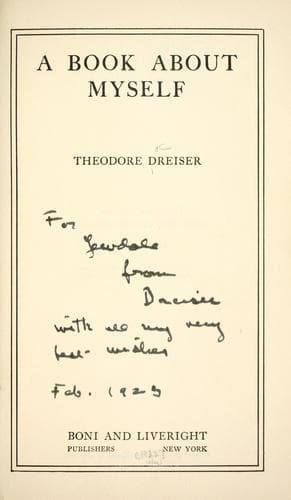
Dreiser, Theodore, 1871-1945; Journalists -- United States -- Biography; Novelists, American -- 20th century -- Biography
I went to my room and studied this paper—then slept, thinking of my
coming introduction in the morning. I was awakened by the clangor of
countless cars. Going to the stationary washstand I was struck at once
by the yellowness of the water, a dark yellowish-brown, which deposited
a yellow sediment in the glass. Was that the best St. Louis could
afford? I asked myself in youthful derision. I drank it just the same,
went down to breakfast and then out into the city to see what I should
see. I bought a _Globe-Democrat_ (a Republican party paper, by the way:
an anachronism of age and change of ownership) and a _Republic_, the one
morning Democratic paper, and then walked to Sixth and Pine to have
another look at the building in which I was to work. I wandered along
Broadway and Fourth Street, the street of the old courthouse; sought out
the Mississippi River and stared at it, that vast river lying between
banks of yellow mud; then I went back to the office of the
_Globe-Democrat_, for it was nearing the time when its editor-in-chief
might choose to put in an appearance.
Joseph B. McCullagh (“Little Mac” of Eugene Field’s verse) was a short,
thick, aggressive, rather pugnacious and defensive person of Irish
extraction. He was short, sturdy, Napoleonic, ursine rather than
leonine. I was instantly drawn and thrown back by his stiff reserve. A
negro elevator boy had waved me along a marble hall on the seventh floor
to a room at the end, where I was met by an office boy who took in my
name and then ushered me into the great man’s presence. I found him at a
roll-top desk in a minute office, and he was almost buried in discarded
newspapers. I learned afterward that he would never allow these to be
removed until he was all but crowded out. I was racked with nervousness.
Whatever high estimate I had conceived of myself had oozed out by the
time I reached his door. I was now surveyed by keen gray Irish eyes from
under bushy brows.
“Um, yuss! Um, yuss!” was all he deigned to say. “See Mr. Mitchell in
the city room, Mr. Mitchell—um, yuss. Your salary will be—um—um—twenty
dollars to begin with” (he was chewing a cigar and mumbled his words),
and he turned to his papers.
Not a word, not a sign, that he knew I had ever written a line worth
while. I returned to the handsome city room, and found only empty desks.
I sat down and waited fully three-quarters of an hour, examining old
papers and staring out of the windows over the roofs until Mr. Mitchell
appeared.
Like his employer, he was thick-set, a bigger man physically but less
attractive. He had a round, closely-cropped head and a severe and
scowling expression. He reminded me of Squeers in _Nicholas Nickleby_. A
savage fat man—can anything be worse? He went to his desk with a quick
stride when he entered, never noticing me. When I approached and
explained who I was and why I was there he scarcely gave me a glance.
Public-domain text, read in full here on John Shaqi.
Reviews
Reviews
No reviews yet
Be the first to share your thoughts on this work.
Join the Discussion
Join the discussion
Sign in to leave a comment or review.
Sign InorCreate an account