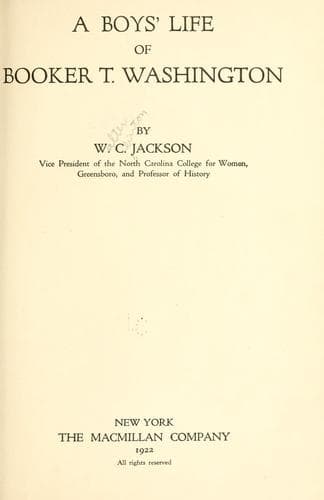
A boys' life of Booker T. WashingtonJackson, Walter Clinton
History
A boys' life of Booker T. Washington
Jackson, Walter Clinton
African American educators -- Biography -- Juvenile literature; Washington, Booker T., 1856-1915 -- Juvenile literature
TRUCK GARDENING, TUSKEGEE INSTITUTE
]
He wanted the children to study practical things; the things they
needed. He thought, therefore, that the school ought to be very closely
related to life. His idea was that that school was best which turned out
students who could earn their own living at once; who had the ability to
take care of themselves in whatever environment they happened to be; and
who had genuine character. “My experience has taught me,” he says, “that
the surest way to success in education, and in any other line for that
matter, is to stick close to the common and familiar things—things that
concern the greater part of the people the greater part of the
time.”[26]
It was this belief in the close relation between school and life that
caused him to have his students, at the beginning of the building of
Tuskegee, cut down the trees, plant the crops, make the bricks, build
the buildings, cook the food, care for the dormitories, look after the
live stock, and do everything that was to be done about the place. He
wanted his students to learn to do well all these tasks that they would
face in later life. And he also wanted them to learn that it was a
perfectly honorable and dignified and sensible thing to labor, to work,
to do anything that was honest and useful.
Perhaps there is no better way of understanding Washington’s ideas of
education and just what he was striving to do at Tuskegee than to
describe the commencement exercises at this school.
“On the platform before the audience is a miniature engine to which
steam has been piped, a miniature frame house in course of construction,
and a piece of brick wall in process of erection. A young man in jumpers
comes on the platform, starts the engine and blows the whistle.
Whereupon young men and women come hurrying from all directions, and
each turns to his or her appointed task. A young carpenter completes the
little house, a young mason finishes the laying of the brick wall, a
young farmer leads forth a cow and milks her in full view of the
audience, a sturdy blacksmith shoes a horse, and, after this patient,
educative animal has been shod, he is turned over to a representative of
the veterinary division to have his teeth filed. At the same time, on
the opposite side of the platform one of the girl students is having a
dress fitted by one of her classmates, who is a dressmaker. She at
length walks proudly from the platform in her completed new gown, while
the young dressmaker looks anxiously after to make sure that it ‘hangs
right behind.’ Other girls are doing washing and ironing with the
drudgery removed in accordance with advanced Tuskegee methods. Still
others are hard at work on hats, mats, and dresses, while boys from the
tailoring department sit cross-legged working on suits and uniforms. In
the background are arranged the finest specimens which scientific
agriculture has produced on the farm and mechanical skill has turned out
in the shop.
Public-domain text, read in full here on John Shaqi.
Reviews
Reviews
No reviews yet
Be the first to share your thoughts on this work.
Join the Discussion
Join the discussion
Sign in to leave a comment or review.
Sign InorCreate an account