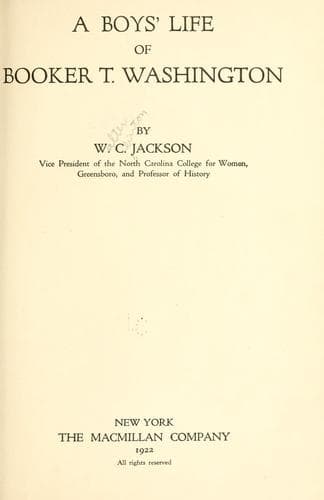
A boys' life of Booker T. WashingtonJackson, Walter Clinton
History
A boys' life of Booker T. Washington
Jackson, Walter Clinton
African American educators -- Biography -- Juvenile literature; Washington, Booker T., 1856-1915 -- Juvenile literature
“One of our students in his commencement oration last May gave a
description of how he planted and raised an acre of cabbages. Piled high
upon the platform by his side were some of the largest and finest
cabbages I have ever seen. He told how and where he had obtained the
seed; he described his method of preparing and enriching the soil, of
working the land, and harvesting the crop; and he summed up by giving
the cost of the whole operation. In the course of his account of this
comparatively simple operation, this student had made use of much that
he had learned in composition, grammar, mathematics, chemistry, and
agriculture. He had not merely woven into his narrative all these
various elements that I have referred to, but he had given the audience
(which was made up largely of colored farmers from the surrounding
country) some useful and practical information in regard to a subject
which they understood and were interested in. I wish that any one who
does not believe it possible to make a subject like cabbages interesting
in a commencement oration could have heard the hearty cheers which
greeted the speaker when, at the close of his speech, he held up one of
the largest cabbages on the platform for the audience to look at and
admire. As a matter of fact there is just as much that is interesting,
strange, mysterious and wonderful; just as much to be learned that is
edifying, broadening, and refining in a cabbage as there is in a page of
Latin. There is, however, this distinction; it will make very little
difference to the world whether one negro boy, more or less, learns to
construe a page of Latin. On the other hand, as soon as one negro boy
has been taught to apply thought and study and ideas to the growing of
cabbages, he has started a process which, if it goes on and continues,
will eventually transform the whole face of things as they exist in the
South to-day.”[28]
It can be readily seen from these two accounts just what kind of
education Washington believed in and tried to give his students at
Tuskegee. It was quite different from most of the training that had been
given the negro after the war. In those early days of freedom, many of
the negroes seemed to have the idea that the bigger the book and the
harder the words in it, the better the education was that they secured.
Some of them thought, too, that they were not educated unless they
studied Latin and Greek and higher mathematics, and other similar
subjects. Booker Washington did not mean that history, literature, and
foreign languages should not be studied and had no value. What he was
emphasizing was the fact that boys and girls should first get a clear
idea of things about them. Then they would be able better to understand
and appreciate such subjects as history and literature.
Public-domain text, read in full here on John Shaqi.
Reviews
Reviews
No reviews yet
Be the first to share your thoughts on this work.
Join the Discussion
Join the discussion
Sign in to leave a comment or review.
Sign InorCreate an account