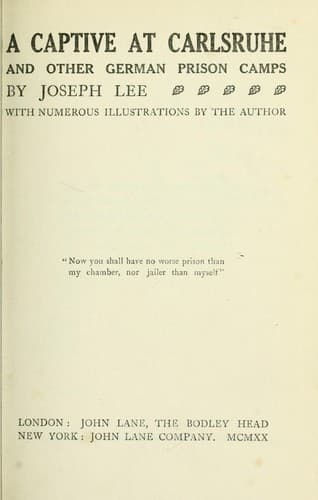
A Captive at Carlsruhe and Other German Prison CampsLee, Joseph
History
A Captive at Carlsruhe and Other German Prison Camps
Lee, Joseph
World War, 1914-1918 -- Personal narratives, British; World War, 1914-1918 -- Prisoners and prisons, German
At all points, and indeed acting as police for the city, are soldiers
and sailors of the security service with white bands on their arms.
Large parties of these men patrol the streets, with a peculiar movement
in the column due to juxtaposition of the measured military step, and
the easy swing of the sailor. We would pass such companies with a
more or less unseeing eye, but we are continually assailed by cheery
greetings of “Wie geht’s?” and “Guten Morgen!”
If we pause before a public building, a soldier or sailor immediately
approaches and asks if we desire to enter. In suchwise we get glimpse
of a number of the important public institutions, including the modern
and rather magnificent Royal Library. In the Royal Opera House, despite
the revolution, performances are announced for to-night of Verdi’s
“Otello,” for to-morrow (Sunday) night of “Rigoletto.”
Some of the streets running off Unter den Linden bear marks of
yesterday’s fighting; some of them are still big with agitation;
groups and queues of gesticulating soldiers and civilians. We pass the
Legations and through the Brandenburger Tor into the Tiergarten, and
take leisurely view of the Reichstag, looking deserted and dejected,
and as if all the glory of debate had departed from it for ever. Here
is the Siegessäule and the Denkmal to Bismarck, Moltke, and the long
lineage of German warriors. Here also is the Hindenburg statue, looking
decidedly forlorn and rather foolish. Tim and I decide that it would
hardly be expedient for us to drive in a couple of nails!
LIEBKNECHT AND ROSA LUXEMBURG
Now approaches a great procession of men and women, silent, sad,
slow-moving, sombre-hued save for the red banners which here and there
droop into the ranks and show through the trees like gouts of blood.
It is the Spartacusbundes Party, with Liebknecht and Rosa Luxemburg at
their head. They are doubtless come to mourn their dead of yesterday
and to demand redress and revenge. The procession winds its way through
the paths, and ultimately the speakers take up position beside the
statue of one of the Margraves, where Liebknecht’s father agitated
before him in less agitated times than these.
Liebknecht speaks now, fiercely and with arms outflung and disturbed as
the leafless branches of the trees which form a background. There is a
wild scream and the crowd commences to stampede. The motor-waggons of
the Security Service of the Social Democratic Party are coming up, grim
and grinning with machine-guns. A terrified crowd is a very terrible
thing.
My last experience of its blind whirl and bewilderment was when the
Germans shelled Béthune with big guns at long range on a market Monday
of August, 1916. We looked like having trouble now. “Through force of
habit they will doubtless take their sighting shots on us,” I said to
Tim.
Public-domain text, read in full here on John Shaqi.
Reviews
Reviews
No reviews yet
Be the first to share your thoughts on this work.
Elsewhere in the archive
Join the Discussion
Join the discussion
Sign in to leave a comment or review.
Sign InorCreate an account