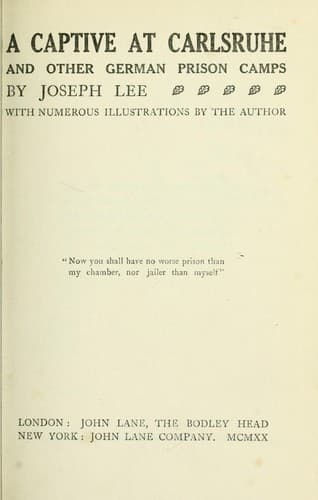
A Captive at Carlsruhe and Other German Prison CampsLee, Joseph
History
A Captive at Carlsruhe and Other German Prison Camps
Lee, Joseph
World War, 1914-1918 -- Personal narratives, British; World War, 1914-1918 -- Prisoners and prisons, German
Four o’clock. We pass through the gate of the old Bischofsschloss for
the last time. As we go down the street one of the officers shows me
the great padlock which he has carried off in his pocket as a souvenir!
If he had been a Samson, he would doubtless have preferred the gate
itself!
The people stand at doors and windows and wave us farewell. Auf
Wiedersehen! Some of the passers-by insist on shaking us by the hand
and wishing us God-speed. We have become familiar to them--and not too
fearful--during the past five months. At the station there is something
of a crowd; as the train moves out there is something of a cheer.
By nine o’clock we are once more in Berlin. We hire a whole squadron of
dilapidated hackney coaches and move in somewhat whimsical procession
for an hour through the already dark and almost deserted streets.
* * * * *
Warnemünde. We pass immediately from the train to the quay, where the
Danish ship _Prins Christian_ is lying with steam up. A Danish officer
is in waiting at the gangway, and as each officer answers to his name
he passes over the ship’s side--a free man once more.
Lieut. Kruggel descends to the saloon to bid us good-bye. He shakes
hands all round.
“Es ist vollbracht,” I said.
“Es ist vollbracht,” he replied.
And with a military salute, he turned, and, a suggestion of sadness in
the stoop of his shoulders, made his way up the companion ladder.
THE END.
FOOTNOTE:
[1] Two days later, in the train for Copenhagen, I gave up my seat
willingly to a little boy with a face of great intellectuality, who
was obviously in a very delicate state of health. This was accepted
gratefully for the lad by the two Danish gentlemen who had him in
charge. They told me that he was the son of Herr Duncker, Professor
of Philosophy in the Berlin University, and one of the leaders of the
Spartacusbund; that they were taking him to Copenhagen, where his elder
brother already was, partly because he was suffering from malnutrition,
but principally for safety, neither his father nor mother expecting
to survive the Revolution. A sister of eighteen or nineteen stays
with her parents. The boy’s guardians also informed me that the lad,
who was only nine years old, already wrote verse which would not be
discreditable to a young man, and that his brother had in a few months
become the chief scholar in the Copenhagen school.
* * * * *
BALLADS OF BATTLE AND WORK-A-DAY WARRIORS
By Lieut. JOSEPH LEE
_SOME PRESS OPINIONS_
_The Times._--“There is real fibre and lifeblood in them, and they
never fail to hold the attention.”
_The Spectator._--“Of the verse that has come straight from the
trenches, the BALLADS OF BATTLE are among the very best.”
Public-domain text, read in full here on John Shaqi.
Reviews
Reviews
No reviews yet
Be the first to share your thoughts on this work.
Elsewhere in the archive
Join the Discussion
Join the discussion
Sign in to leave a comment or review.
Sign InorCreate an account