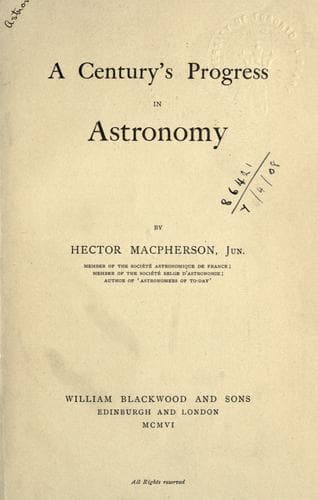
A Century's Progress in AstronomyMacpherson, Hector
History
A Century's Progress in Astronomy
Macpherson, Hector
Astronomy -- History
Adams thought the matter trivial, and did not
reply. Airy, therefore, took no interest in the investigations, and no
steps were taken to search for the unseen planet. Meanwhile the Rev. W.
R. Dawes happened to see Adams’ papers lying at Greenwich, and wrote to
his friend, the well-known astronomer Lassell, who was in possession of
a very fine reflector, erected at his residence near Liverpool, asking
him to search for the planet. But Lassell was suffering from a sprained
ankle, and Dawes’ letter was accidentally destroyed by a housemaid. So
Adams’ theory remained in obscurity.
The question now came under the notice of _François Jean Dominique
Arago_ (1786-1853), the director of the Paris Observatory. He recognised
in a young friend of his a rising genius, who was competent to solve the
problem. Urban Jean Joseph Le Verrier, born at Saint Lo, in Normandy, in
1811, became in 1837 astronomical teacher in the École Polytechnique,
and in 1853 director of the Paris Observatory. In consequence of
differences with his staff he was obliged, in 1870, to resign from this
position, but two years later was restored to the post, which he held
till his death on September 23, 1877.
In 1845, ignorant of the fact that Adams had already solved the problem,
Le Verrier began his investigations of the irregular motions of Uranus.
In a memoir communicated to the Academy of Sciences in November of that
year, he demonstrated that no known causes could produce these
disturbances. In a second memoir, dated June 1, 1846, he announced that
an exterior planet alone could produce these effects. But Le Verrier had
now before him the difficult task of assigning an approximate position
to the unseen body, so that it might be telescopically discovered. After
much calculation Le Verrier, in his third memoir (August 31, 1846),
assigned to the planet a position in the constellation Aquarius.
Meanwhile one of Le Verrier’s papers happened to reach Airy. Seeing its
resemblance to Adams’ papers, which had been lying on his desk for
months, his scepticism vanished, and he suggested to Challis that the
planet should be searched for with the Cambridge equatorial. In July
1846 the search was commenced. The planet was actually observed on
August 4 and 12, but, owing to the absence of star maps, it was not
recognised. “After four days of observing,” he wrote to Airy, “the
planet was in my grasp if I had only examined or mapped the
observations.”
Public-domain text, read in full here on John Shaqi.
Reviews
Reviews
No reviews yet
Be the first to share your thoughts on this work.
Join the Discussion
Join the discussion
Sign in to leave a comment or review.
Sign InorCreate an account