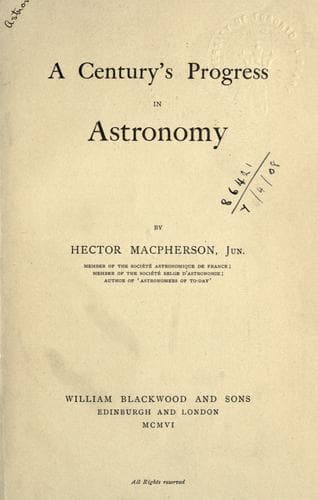
A Century's Progress in AstronomyMacpherson, Hector
History
A Century's Progress in Astronomy
Macpherson, Hector
Astronomy -- History
Le Verrier wrote to Encke, the illustrious director of the Berlin
Observatory, desiring him to make a telescopic search for a planetary
object situated in the constellation Aquarius, as bright as a star of
the eighth magnitude and possessed of a visible disc. “Look where I tell
you,” wrote the French astronomer, “and you will see an object such as I
describe.” Encke ordered his two assistants, Galle and D’Arrest, to make
a search on the night of September 23, 1846. In a few hours Galle
observed an object not marked in the star-maps of the Berlin
Observatory, which had been recently published. The following night
sufficed to show that the object was in motion, and was therefore a new
planet. On September 29 Challis found the planet at Cambridge, but he
was too late, as the priority of the discovery was now lost to Adams.
The planet received the name of “Neptune.”
For some time, indeed, it appeared as if the French astronomer alone was
to receive the honour of the discovery. But on October 3, 1846, a letter
from Sir John Herschel appeared in the ‘Athenæum’ in which he referred
to the discovery made by Adams. The French scientists were extremely
jealous. Indeed, Arago actually declared that, when Neptune was under
discussion, the entire honour should go to Le Verrier, and the name of
Adams should not even be mentioned,—Arago’s line of reasoning being that
it was not the man who first made a discovery who should receive the
credit, but he who first made it public. However, the credit of the
discovery is now given equally to Adams and Le Verrier, both of whom are
regarded as among the greatest of astronomers.
Only a fortnight after the discovery of Neptune, the astronomer Lassell
observed a satellite to the distant planet on October 10, 1846. This
discovery was confirmed in July 1847 by the discoverer himself, and
shortly afterwards by Bond and Otto Struve. Regarding the globe of
Neptune, we know practically nothing. No markings of any kind have been
observed on its surface. However, in 1883 and 1884, _Maxwell Hall_, an
astronomer in Jamaica, noticed certain variations of brilliance which
suggested a rotation-period of eight hours, but this was not confirmed
by any other astronomer. The spectrum of Neptune has been investigated
by various observers, who have found it to be similar to that of Uranus.
Public-domain text, read in full here on John Shaqi.
Reviews
Reviews
No reviews yet
Be the first to share your thoughts on this work.
Join the Discussion
Join the discussion
Sign in to leave a comment or review.
Sign InorCreate an account