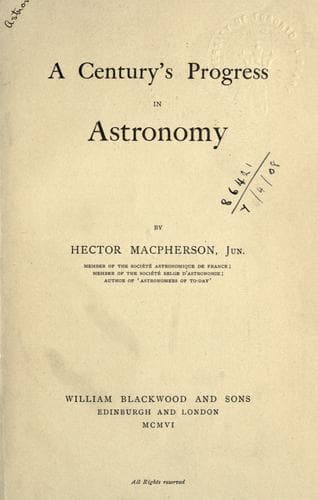
A Century's Progress in AstronomyMacpherson, Hector
History
A Century's Progress in Astronomy
Macpherson, Hector
Astronomy -- History
Heinrich Wilhelm Matthias Olbers was born at Arbergen, a village near
Bremen, October 11, 1758. His father was a clergyman who, in addition to
considerable mathematical powers, was an enthusiastic lover of
astronomy. At the age of thirteen young Olbers became deeply interested
in that science. While taking an evening walk in the month of August, he
observed the Pleiades, and determined to find out to which constellation
they belonged. He therefore bought some books on astronomy, along with a
few charts of the sky, and he began to study the science with much
enthusiasm. He read every book he could lay his hands on, and a few
months sufficed to make him acquainted with all the constellations.
In 1777, when in his nineteenth year, Olbers entered the University of
Göttingen to study medicine, and at the same time he learned much
regarding mathematics and astronomy from the mathematician Kaestner.
When twenty-one years of age he observed the stars at Göttingen, and
devised a method of calculating the orbits of comets, the idea coming to
him while he was attending at the bedside of a fellow-student who had
taken ill. “Although not made public until 1797,” writes Miss Clerke,
“‘Olbers’ method’ was then universally adopted, and is still regarded as
the most expeditious and convenient in cases where absolute rigour is
not required. By its introduction, not only many a toilsome and
thankless hour was spared, but workers were multiplied and encouraged in
the pursuit of labours more useful than attractive.”
Towards the end of 1781 he returned to Bremen, settled as a medical
doctor, and continued in practice for about forty-one years. But
although he had adopted perhaps the most toilsome profession, his love
of science prevailed, and night after night he explored the heavens with
untiring zeal. He never slept more than four hours, and the upper part
of his house in the Sandgasse, in Bremen, was fitted up with
astronomical instruments. The largest telescope which he possessed was a
refractor 3¾ inches in aperture. He remained in active practice till
1823, when he retired, and was enabled to devote more attention to his
beloved science. He died on March 2, 1840, at the advanced age of
eighty-one.
Public-domain text, read in full here on John Shaqi.
Reviews
Reviews
No reviews yet
Be the first to share your thoughts on this work.
Join the Discussion
Join the discussion
Sign in to leave a comment or review.
Sign InorCreate an account