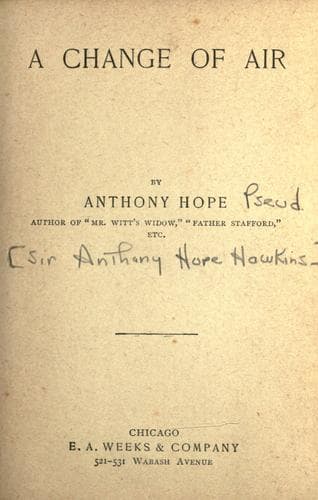
Country homes -- Fiction; England -- Social life and customs -- 19th century -- Fiction; Fame -- Fiction; Poets -- Fiction
The Colonel came home to luncheon in very good spirits. He had just
succeeded, in the interests of freedom, in stirring up a spirit of
active revolt in Alderman Johnstone. The Alderman had hitherto, like
his father before him, occupied his extensive premises on a weekly
tenancy; he had never been threatened with molestation or eviction; but
he felt that he existed on sufferance, and the consciousness of his
precarious position had been irksome to him. A moment had come when
the demand for houses was slack, when two or three were empty, and
when the building trade itself was nearly at a standstill. The Colonel
had incited Johnstone to seize the opportunity to ask from the Squire
a lease, and Johnstone had promised to take nothing less than "seven,
fourteen, or twenty-one." If refused, he declared he would surrender
the premises and build for himself on some land of the Colonel's just
outside the town.
"Delane must grant it," said the Colonel, rubbing his hands, "and then
we shall have one house anyhow where our bills can be put up. Bannister
will be delighted. By the way, Tora, he wants us to go in to tea
to-day, after skating. I suppose you're going to skate?"
"I am going to skate, but I am not going to Mr. Bannister's," said Tora
coldly.
"Why not?"
The Colonel was told why not with explicitness and vehemence. He tugged
his white whisker in some perplexity: he did not mind much about the
poems, though, of course, no excess of scrupulousness could be too
great in a girl like Tora; but if she were right about the other
affair! That must be looked into.
The Colonel was one of those people who pride themselves on tact and
_savoir faire_; he aggravated this fault by believing that tact and
candor could be combined in a happy union, and he determined to try the
effect of the mixture on Dale Bannister. It would go hard if he did not
destroy this mare's nest of Tora's.
All the neighborhood was skating on the Grange lake under a winter sun,
whose ruddy rays tinged the naked trees, and drew an answering glitter
from the diamond-paned windows of the house. The reeds were motionless,
and the graze of skaters on the ice sounded sharp in the still air, and
struck the ear through the swishing of birch brooms and the shuffle of
sweepers' feet. From time to time a sudden thud and a peal of laughter
following told of disaster, or there grated across the lake a chair,
carrying one who preferred the conquest of men to the science of
equilibrium. Rosy cheeks glowed, nimble feet sped, and lissom figures
swayed to and fro as they glided over the shining surface, till even
the old and the stout, the cripples and the fox hunters, felt the glow
of life tingling in their veins, and the beauty of the world feeding
their spirits with fresh desire. "It is not all of life to live," but,
at such a moment, it is the best part of it.
Public-domain text, read in full here on John Shaqi.
Reviews
Reviews
No reviews yet
Be the first to share your thoughts on this work.
Join the Discussion
Join the discussion
Sign in to leave a comment or review.
Sign InorCreate an account