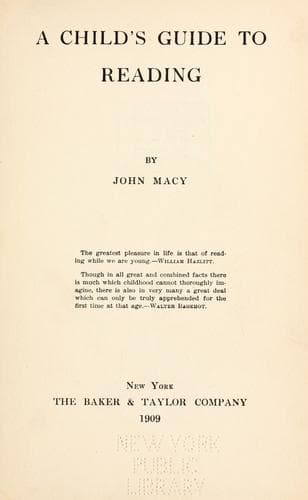
Books and reading; Children's literature -- Bibliography
The Cambridge Edition is the best, in one volume. The Globe Edition is
in two volumes. The two volumes in _Everyman’s Library_ contain all of
Browning’s poems written up to 1864. A good volume for the young reader
is “The Boys’ Browning,” which contains poems of action and incident.
An inexpensive volume, published by Smith, Elder & Co., called “The
Brownings for the Young,” contains a good variety of Browning, with
some selections from Mrs. Browning.
WILLIAM CULLEN BRYANT (1794-1878). _Poetical Works._
The poems of Bryant are published in one volume by D. Appleton & Co.
Bryant’s translations of the “Iliad” and the “Odyssey” are better than
most poetic versions of Homer in simplicity and dignity. The young
reader cannot do better than to meet Homer in Bryant before he learns
Greek enough to meet Homer himself.
ROBERT BURNS (1759-96). _Poems, Songs, and Letters._
The complete work of Burns in the Globe Edition (Macmillan).
GEORGE GORDON NOEL BYRON (1788-1824). _Poetry of Byron._
A selection by Matthew Arnold in the _Golden Treasury Series_.
CHARLES STUART CALVERLEY (1831-84). _Fly Leaves._
A taste for refined parody indicates the possession of a critical
sense. Coarse parody which implies no intimate knowledge of the poet
parodied is not worth while. The reader who appreciates Calverley’s
delicious verses will have learned to appreciate the serious modern
poets. Other writers of humorous verse, including parodies which are
delicate and witty, are J. K. Stephen, Mr. Owen Seaman, Henry Cuyler
Bunner.
THOMAS CAMPBELL (1777-1844).
Enough of Campbell will be found in Ward’s Poets.
GEORGE CHAPMAN (1559-1634). _Dramas._
One volume in the _Mermaid Series_. (See pages 243-8 of this Guide.)
GEOFFREY CHAUCER (1340-1400). _Canterbury Tales._
A volume in _Everyman’s Library_ contains eighteen of the tales,
slightly simplified in spelling and vocabulary, said to be the first
successful attempt to modernize Chaucer, for the benefit of the
ordinary reader, without destroying the essential quality of the
original. But with the glossary and notes found in “The Student’s
Chaucer,” edited by W. W. Skeat, the lover of poetry will find himself
able to read Chaucer in the original form without great difficulty.
ARTHUR HUGH CLOUGH (1819-61). _Poems._
In the _Golden Treasury Series_. Readers of poetry who have not met
Clough have an entirely new poetical experience before them in “The
Bothie,” a narrative poem. It should be tried after Longfellow’s
“Miles Standish” and “Evangeline.” Clough was not among the greatest
Victorian poets, but there is room for him in an age like ours which is
said, whether justly or not, to be lacking in poetic voices. In this
connection readers may turn to Clough’s poem, “Come, Poet Come!” (see
page 107 of this Guide).
SAMUEL TAYLOR COLERIDGE (1772-1834). _Poetical Works._
In the Globe Edition. The single volume in _Everyman’s Library_ is
adequate.
WILLIAM COWPER (1731-1800). _Poetical Works._
Public-domain text, read in full here on John Shaqi.
Reviews
Reviews
No reviews yet
Be the first to share your thoughts on this work.
Join the Discussion
Join the discussion
Sign in to leave a comment or review.
Sign InorCreate an account