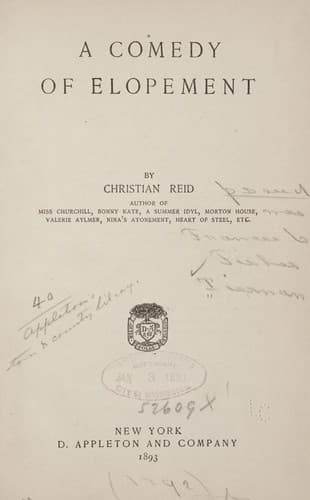
Florida -- Fiction; Man-woman relationships -- Fiction; Young women -- Fiction
She shook her head. “How could it?” she asked. “Fanny has never had
the courage to tell her husband the truth. But nothing disagreeable
has arisen from it--to me, I mean,” she added, a little hurriedly.
“You know you were afraid of that.”
“Yes,” he said. “I am very glad that you have never been annoyed;
still, it is a shame that such a belief should be in the mind of
any one with regard to you.”
He spoke out, quickly and hotly, the indignation that on this
subject was always within him and ready to find expression; but
he was sorry the next moment for the words when he saw a swift
blush rise into her face, as with the sudden realization of what
the belief was to which he alluded. Angry with himself, he went on
hastily:
“This being so--I mean, the burden of Mrs. Meredith’s conduct
being still borne by you--I feel that I am bound to abstain on
my part from anything which might cause you the least annoyance;
and so I have determined to go away. There shall not be the least
misapprehension about you, arising from any act of mine.”
So much was truth; but, like many other people, Kyrle did not find
it advisable to tell all the truth. He could not say, “Also, I am
going, because if I stay I shall fall in love with you, and that
will never do, for I am a poor man, and you are a rich woman.” But
this was in his mind, even while the temptation was growing greater
every instant to forget both of these stubborn facts. Aimée was
silent for a moment, and then--for the old courage, as well as the
old simplicity, was still strong in her--she looked at him with her
brave, direct glance, and said:
“If this is your reason for leaving Venice, I hope that you will
not think of going. Your presence does not cause me the least
annoyance; and I should be more sorry than I can tell you if mine
were such an annoyance to you that we could not even remain in the
same city. For, do you think I forget that if you are in a false
position, it was my obstinacy that placed, or at least kept you
there? How earnestly you appealed to me, and I could not yield!
And are you now to be the sufferer by being driven away from this
heavenly place? No, Mr. Kyrle, there is no justice in that. I will
not allow it!”
He could have smiled at the energy with which she spoke, partly
because he read in it the old generous spirit, taking no heed or
thought of herself, and partly because, in urging him to remain,
she proved that she so little suspected the chief reason why
departure seemed to him necessary. What he would have answered it
is hard to say, for at that moment the maid, bearing some packages,
made her appearance, and Aimée, rousing to the consciousness
that there was something very unconventional in this prolonged
conversation, rose rather hastily, bade him good-morning, and
walked away.
* * * * *
“Going to leave Venice?” said Fanny Meredith. “What an absurd idea!
What do you mean by it?”
Public-domain text, read in full here on John Shaqi.
Reviews
Reviews
No reviews yet
Be the first to share your thoughts on this work.
Elsewhere in the archive
Join the Discussion
Join the discussion
Sign in to leave a comment or review.
Sign InorCreate an account