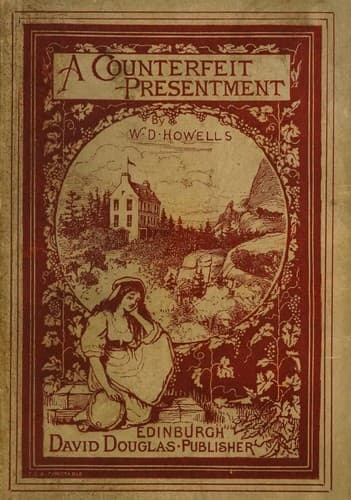
A Counterfeit Presentment; and, The Parlour CarHowells, William Dean
General
A Counterfeit Presentment; and, The Parlour Car
Howells, William Dean
American drama -- 19th century; Man-woman relationships -- Drama
_Bartlett._--"Well, go! You're of no advantage here. You'd have it
out, would you? Well, then, I wouldn't. I'm a brute, I know, and a fool,
but I'm not such a brute and fool as that!" Cummings listens with
smiling patience, and then goes without reply, while Bartlett drops into
the chair near the easel, and sulkily glares at the picture. Through the
window at his back shows the mellow Indian summer landscape. The trees
have all dropped their leaves, save the oaks which show their dark
crimson banners among the deep green of the pines and hemlocks on the
hills; the meadows, verdant as in June, slope away toward the fringe of
birches and young maples along the borders of the pond; the
low-blackberry trails like a running fire over the long grass limp from
the first frosts, which have silenced all the insect voices. No sound of
sylvan life is heard but the harsh challenge of a jay, answered from
many trees of the nearest wood-lot. The far-off hill-tops are molten in
the soft azure haze of the season; the nearer slopes and crests sleep
under a greyer and thinner veil. It is to this scene that the painter
turns from the easel, with the sullen unconsciousness in which he has
dwelt upon the picture. Its beauty seems at last to penetrate his mood;
he rises and looks upon it; then he goes out on the gallery, and, hidden
by the fall of one of the curtains, stands leaning upon the rail and
rapt in the common reverie of the dreaming world. While he lingers
there, Cummings appears at the door, and looks in; then with an air of
some surprise, as if wondering not to see Bartlett, vanishes again, to
give place to General Wyatt, who after a like research retires silently
and apparently disconcerted. A few moments later Mrs. Wyatt comes to the
threshold, and calling gently into the room, "Constance!" waits briefly
and goes away. At last, the young girl herself appears, and falters in
the doorway an instant, but finally comes forward and drifts softly and
indirectly up to the picture, at which she glances with a little sigh.
At the same moment Bartlett's voice, trolling a snatch of song, comes
from the gallery without:--
ROMANCE.
I.
Here apart our paths, then, lie:
This way you wend, that way I;
Speak one word before you go:
Do not, do not leave me so!
II.
What is it that I should say?
Tell me quick; I cannot stay;
Quick! I am not good at guessing:
Night is near, and time is pressing.
III.
Nay, then, go! But were I you,
I will tell you what I'd do:
Rather than be baffled so,
I would never, never go!
As the song ends, Bartlett reappears at the gallery door giving into
the parlour, and encounters Constance turning at his tread from the
picture on which she has been pensively gazing while he sang. He puts up
a hand on either side of the door.
IV.
BARTLETT _and_ CONSTANCE.
_Bartlett._--"I didn't know you were here."
_Constance._--"Neither did I--know you were, till I heard you singing."
Public-domain text, read in full here on John Shaqi.
Reviews
Reviews
No reviews yet
Be the first to share your thoughts on this work.
Join the Discussion
Join the discussion
Sign in to leave a comment or review.
Sign InorCreate an account