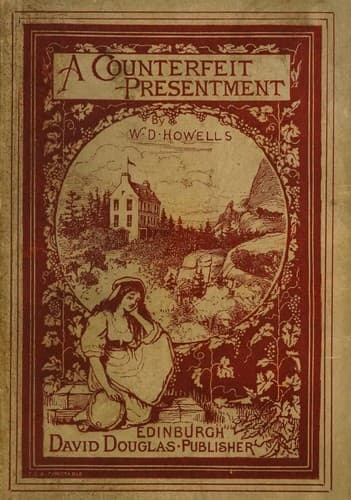
A Counterfeit Presentment; and, The Parlour CarHowells, William Dean
General
A Counterfeit Presentment; and, The Parlour Car
Howells, William Dean
American drama -- 19th century; Man-woman relationships -- Drama
_Constance._--"You shall not go now till you know what despised and
hated and forsaken thing you've offered your love to."
_Bartlett_, beseechingly.--"Constance, let me go while I can forgive
myself. Nothing you can say will make me love you less; remember that;
but I implore you to spare yourself. Don't speak, my love."
_Constance._--"Spare myself? Not speak? Not speak what has been on my
tongue and heart and brain, a burning fire, so long?-- Oh, I was a happy
girl once! The days were not long enough for my happiness; I woke at
night to think of it. I was proud in my happiness and believed myself,
poor fool, one to favour those I smiled on; and I had my vain and crazy
dreams of being the happiness of some one who should come to ask
for--what you ask now. Some one came. At first I didn't care for him,
but he knew how to make me. He knew how to make my thoughts of him part
of my happiness and pride and vanity till he was all in all, and I had
no wish, no hope, no life but him; and then he--left me!" She buries her
face in her hands again, and breaks into a low, piteous sobbing.
_Bartlett_, with a groan of helpless fury and compassion.--"The fool,
the sot, the slave! Constance, I knew all this,--I knew it from the
first."
_Constance_, recoiling in wild reproach.--"You _knew_ it?"
_Bartlett_, desperately.--"Yes, I knew it--in spite of myself,
through my own stubborn fury I knew it, that first day, when I had
obliged my friend to tell me what your father had told him, before I
would hear reason. I would have given anything not to have known it
then, when it was too late, for I had at least the grace to feel the
wrong, the outrage of my knowing it. You can never pardon it, I see; but
you must feel what a hateful burden I had to bear, when I found that I
had somehow purloined the presence, the looks, the voice of another
man--a man whom I would have joyfully changed myself to any monstrous
shape _not_ to resemble, though I knew that my likeness to him,
bewildering you in a continual dream of him, was all that ever made you
look at me or think of me. I lived in the hope--Heaven only knows why I
should have had the hope!--that I might yet be myself to you; that you
might wake from your dream of him and look on me in the daylight, and
see that I was at least an honest man, and pity me and may be love me at
last, as I loved you at first, from the moment I saw your dear pale
face, and heard your dear, sad voice." He follows up her slow retreat
and again possesses himself of her hand: "Don't cast me off! It was
monstrous, out of all decency, to know your sorrow; but I never tried to
know it; I tried _not_ to know it." He keeps fast hold of her hand,
while she remains with averted head. "I love you, Constance; I loved
you; and when once you had bidden me stay, I was helpless to go away, or
I would never be here now to offend you with the confession of that
shameful knowledge. Do you think it was no trial to me? It gave me the
Public-domain text, read in full here on John Shaqi.
Reviews
Reviews
No reviews yet
Be the first to share your thoughts on this work.
Elsewhere in the archive
Join the Discussion
Join the discussion
Sign in to leave a comment or review.
Sign InorCreate an account