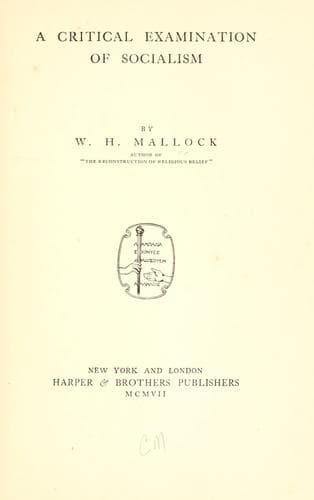
A Critical Examination of SocialismMallock, W. H. (William Hurrell)
Philosophy
A Critical Examination of Socialism
Mallock, W. H. (William Hurrell)
Communism; Socialism
business were managed by the College of Cardinals.
And what, under a regime of socialism, would be true of human thought,
a-seeking to embody itself in printed books or newspapers, would be
equally true of it as applied to the methods of industry, and seeking to
embody itself in multiplied or improved commodities.
Such, then, are the disadvantages which socialism, as contrasted with
the existing system, would introduce in connection with the problem of
how to detect, and how, having detected it, to invest with suitable
powers, the men whose ability is, at any given moment, calculated to
raise labour to the highest pitch of productiveness--how to give power
to these, and to take it away from others in exact proportion as their
talents, as exhibited in its practical results, fall short of the
maximum which is at the time obtainable.
This problem, as we have seen already, the existing system solves by its
machinery of private competition, and of independent capitals, which
automatically increase the powers of the ablest directors of labour, and
concurrently decrease or extinguish those of the less able. Socialism,
with its collective capital, and its able men reduced or elevated to the
rank of state officials, while not obviating, but on the contrary
emphasising the necessity for placing labour under the highest directive
ability, or, in other words, the necessity for competition among able
men, would dislocate the only machinery by which such competition can be
made effective; and, if it did not destroy the efficiency of the highest
ability altogether, would reduce this to a minimum, and confine it
within the narrowest limits.
In this chapter, however, we have been dealing with the machinery only.
We have been assuming the unabated activity of the powers by which the
machinery is to be driven. That is to say, we have been assuming that
every man who possesses, or imagines himself to possess, any exceptional
gift for directing labour--whether as an inventor, a man of science, an
organiser, or in any other capacity--would be no less eager, under the
circumstances with which socialism would surround him, to develop and
exert his faculties than he is at the present day. We will now pass on
to the question of how far this assumption is correct. The question of
machinery is secondary. It is a question of detail only; for if there is
no power in the background by which the machinery may be driven, it will
not make much difference in the result whether the machinery be bad or
good.
Public-domain text, read in full here on John Shaqi.
Reviews
Reviews
No reviews yet
Be the first to share your thoughts on this work.
Elsewhere in the archive
Join the Discussion
Join the discussion
Sign in to leave a comment or review.
Sign InorCreate an account