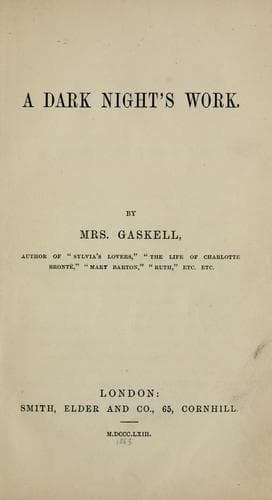
England -- Social life and customs -- 19th century -- Fiction
Ralph's people were not very slow in discovering that something had not
gone on quite smoothly with him at Ford Bank. They knew his ways and
looks with family intuition, and could easily be certain thus far. But
not even his mother's skilfulest wiles, nor his favourite sister's
coaxing, could obtain a word or a hint; and when his father, the squire,
who had heard the opinions of the female part of the family on this head,
began, in his honest blustering way, in their _tete-a-tetes_ after
dinner, to hope that Ralph was thinking better than to run his head into
that confounded Hamley attorney's noose, Ralph gravely required Mr.
Corbet to explain his meaning, which he professed not to understand so
worded. And when the squire had, with much perplexity, put it into the
plain terms of hoping that his son was thinking of breaking off his
engagement to Miss Wilkins, Ralph coolly asked him if he was aware that,
in that case, he should lose all title to being a man of honour, and
might have an action brought against him for breach of promise?
Yet not the less for all this was the idea in his mind as a future
possibility.
Before very long the Corbet family moved _en masse_ to Stokely Castle for
the wedding. Of course, Ralph associated on equal terms with the
magnates of the county, who were the employers of Ellinor's father, and
spoke of him always as "Wilkins," just as they spoke of the butler as
"Simmons." Here, too, among a class of men high above local gossip, and
thus unaware of his engagement, he learnt the popular opinion respecting
his future father-in-law; an opinion not entirely respectful, though
intermingled with a good deal of personal liking. "Poor Wilkins," as
they called him, "was sadly extravagant for a man in his position; had no
right to spend money, and act as if he were a man of independent
fortune." His habits of life were criticised; and pity, not free from
blame, was bestowed upon him for the losses he had sustained from his
late clerk's disappearance and defalcation. But what could be expected
if a man did not choose to attend to his own business?
Public-domain text, read in full here on John Shaqi.
Reviews
Reviews
No reviews yet
Be the first to share your thoughts on this work.
Elsewhere in the archive
Join the Discussion
Join the discussion
Sign in to leave a comment or review.
Sign InorCreate an account