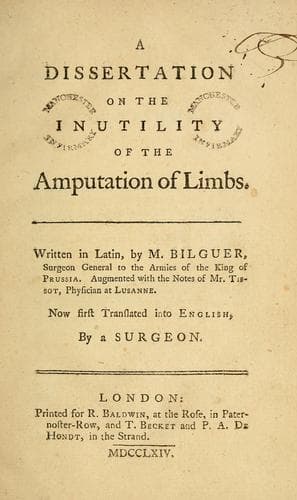
A dissertation on the inutility of the amputation of limbs — John Shaqi
A dissertation on the inutility of the amputation of limbsBilguer, Johann Ulrich
History
A dissertation on the inutility of the amputation of limbs
Bilguer, Johann Ulrich
Amputation -- Early works to 1800
It will here perhaps be objected, that all these means would be to no
purpose, if the brachial or crural arteries are wounded at a certain
height, because, in such a case, the limb must waste away for want of
nourishment. I shall return an answer in a few words, with respect
to the crural artery at the upper part of the thigh, which is, that
whether my method can, or cannot be adopted in this case, there is no
alternative; no surgeon as far as I know having ventured to perform
amputation at this part, because every body would dread the patient's
expiring during the operation[42]: Neither would the wounds of the
brachial artery induce me to take off the arm at its upper part,
although it be practicable, because I think every expedient is to
be tried before we have recourse to this; and as from several cases
we learn, that after the operation for the aneurism the member has
recovered its heat, motion, and strength[43], even when the trunk of
the brachial artery has been cut through; I think when it is wounded,
we ought to tie it without fear, and afterwards provide for the
preservation of the limb, by aperient spirituous fomentations and
by gentle frictions, which contribute to open and enlarge the small
vessels, and by that means to restore heat and life to the parts[44].
If we observe, the first or second day after the operation, a little
swelling or heat below the wound, we may conceive great hopes that the
whole limb will revive: If, on the contrary, whatever is below the
wound shrivels, grows cold and dry, then we may think of amputation,
without, however, being precipitate; as a mortification in this case is
always slow, and sometimes the limb recovers heat and motion very late.
But I am convinced this case will very rarely require amputation. In
conformity to the plan I have proposed, I should now mention the two
last circumstances wherein amputation is deemed necessary, a caries of
the bone, and a cancerous disposition of the part; but I imagine it
will be better first to relate some instances of cures effected without
amputation, wherein this operation to many surgeons would have appeared
indispensable.
Public-domain text, read in full here on John Shaqi.
Reviews
Reviews
No reviews yet
Be the first to share your thoughts on this work.
Join the Discussion
Join the discussion
Sign in to leave a comment or review.
Sign InorCreate an account