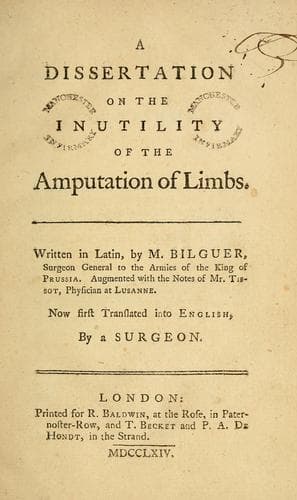
A dissertation on the inutility of the amputation of limbsBilguer, Johann Ulrich
History
A dissertation on the inutility of the amputation of limbs
Bilguer, Johann Ulrich
Amputation -- Early works to 1800
But as they are oftener applicable with respect to amputation, the
expediency of the method I have recommended, stands nevertheless on a
solid foundation. To alleviate the pains and sooth the murmurs of the
sick, we must flatter them with hope; as for the wounds made by the
incisions, they are commonly necessary at a time when they do not
think of complaining or opposing them, and they are much less severe
than the horrible gash made by amputation. The objections arising
from the difficulty attending this method are happily removed in our
hospitals, by the care and humane vigilance which Frederick the Great
has exerted to provide his victorious armies with surgeons capable of
putting it in practice.
SECT. XXXV.
I shall here add that with regard to those who have had the thigh or
arm carried off by a cannon ball, I do not recollect that any of the
first have been brought to our hospital; they doubtless died instantly
in the field of battle, in consequence of the hemorrhage. Several of
those who had the arm carried off were brought, but the camp surgeons
had previously stopt the bleeding, and applied the dressings commonly
used after amputation, and we cured them afterwards by the method
mentioned in § XXXI. The men wounded in this manner afford me an
opportunity of inserting in this place, what I had to say with respect
to the necessity of amputation in consequence of an hemorrhage; but
I shall be very brief, as in these times, when surgery makes such
progress, there is no artist but knows, and is familiarly acquainted
with the different methods of stopping a bleeding. Therefore,
although the interosseous, the brachial and crural arteries, near the
articulations of the elbow or knee, or any other branches of arteries
when divided, may give the surgeon a good deal of trouble, he is not
obliged on that account to take off the limb; for in whatever situation
we suppose the artery to be injured, the surgeon may always, by proper
dilations, come at the wound, and stop the bleeding by the application
of astringents, among which agaric and spirit of turpentine has, with
us, very often succeeded, or by compression or ligatures, or lastly by
all these means united; thus amputation ought never to be performed
on account of an hemorrhage. It is even astonishing to conceive
how surgeons should think of such an expedient, as frequently the
difficulty of stopping the bleeding after amputation is greater than on
any other occasion, especially if it be performed below the knee[41].
I therefore persist in my opinion, whether the wound of the arteries
be only accompanied with one in the soft parts, or whether at the same
time the bone be fractured or shattered: In this last case, I should
join the treatment mentioned in this section to that of § XXIV.
Public-domain text, read in full here on John Shaqi.
Reviews
Reviews
No reviews yet
Be the first to share your thoughts on this work.
Join the Discussion
Join the discussion
Sign in to leave a comment or review.
Sign InorCreate an account