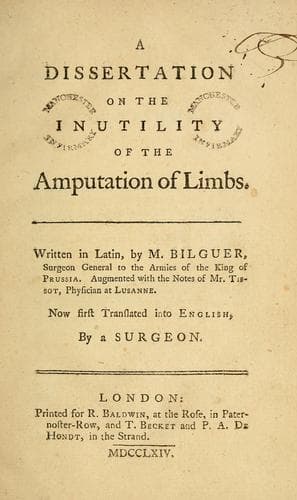
A dissertation on the inutility of the amputation of limbsBilguer, Johann Ulrich
History
A dissertation on the inutility of the amputation of limbs
Bilguer, Johann Ulrich
Amputation -- Early works to 1800
After having dilated the wounds, we extracted some splinters, sawed off
a piece of the cubital bone about four inches long, and in dressing the
wounds endeavoured to avoid too large a suppuration.
In the ordinary method amputation would certainly have been performed,
as the fore-arm was shattered, and the upper arm which was untouched
could admit of the operation, but we saved the arm and made a perfect
cure without having recourse to such an expedient, which are so many
evidences that give their testimony in favour of our method, which we
can produce to the partisans of amputation.
M. de Sass, colonel commandant of a regiment belonging to the garrison
of Lattorf, and who is at present commandant at Brieg, received at the
battle fought near Czeslau, a musket shot in the leg, which shivered
the two bones into several fragments, of which some of four or five
inches in length were extracted. The surgeons thought amputation
necessary, and pressed him to submit to it; he refused however and
recovered; although the limb is bent outwards he can walk and go about
his business with ease.
A soldier of the regiment of Cuirassiers of Gessler, called Lukrafka,
was wounded in the going through the exercise with the regiment, in
such a manner that the two bones were fractured in the middle, with
several fissures lengthways. After having laid the fissures of the
bone bare, I sawed through a piece of the tibia about five inches in
length, which I removed together with the marrow; I separated with a
pair of forceps the useless parts of the fibula which jutted out, then
I placed the bones in their natural position, and at the expiration of
four months the patient was cured. This limb was somewhat shorter than
the other, he could nevertheless walk and leap with ease.
M. de Franckenberg, a captain in Hulsen's regiment of foot, was
terribly wounded by a musket ball at the battle of Loboschitz; all the
bones of the tarsus were broke and shattered in such a manner that it
seemed almost necessary to take away the whole number; which being
done, and the parts of the foot brought close together, it recovered
so far that this gallant officer, with the help of a double heel, can
walk conveniently, and is able to do duty along with his regiment in
garrison at Alt-Sydow.
Public-domain text, read in full here on John Shaqi.
Reviews
Reviews
No reviews yet
Be the first to share your thoughts on this work.
Join the Discussion
Join the discussion
Sign in to leave a comment or review.
Sign InorCreate an account