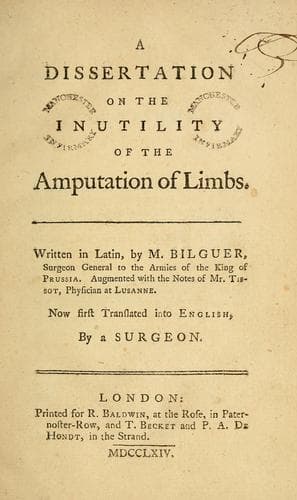
A dissertation on the inutility of the amputation of limbs — John Shaqi
A dissertation on the inutility of the amputation of limbsBilguer, Johann Ulrich
History
A dissertation on the inutility of the amputation of limbs
Bilguer, Johann Ulrich
Amputation -- Early works to 1800
M. de Alvensleben, ensign in the guards, received at Torgau a wound
above the foot which shattered the tibia and fibula, and the splinters
forced by the violence of the shot formed three distinct layers; I
was obliged to make a great many deep incisions, and in a little time
he was so much better, that I could venture to entrust the remainder
of the cure to the surgeon of the regiment. A soldier of Sybourg's
regiment of foot, named Mieke, seventy years of age, received near
Miessen in 1759, a musket shot which shattered the shoulder bone two
fingers breadth below the articulation; a splinter was taken out five
inches long; he was nevertheless perfectly cured at the end of nine
months, and left Wittemberg to go to the hospital of Invalids at Berlin.
M. de Stabenwol, captain lieutenant of Grabow's regiment of foot, at
the battle of Kunnersdorf, received a musket shot which shattered the
head of the os humeri close to its articulation with the scapula; he
was perfectly cured in the space of eight months, and went from Stettin
to Berlin[47].
M. de Rottkirk, commandant of the margrave Charles's regiment, and
M. de Krockow, captain in Schlabrendorf's regiment of Cuirassiers,
received each of them a wound through the joint of the shoulder, and
were both compleatly cured at the expiration of about ten months.
M. de Britzke, commandant of Knobloch's regiment of foot, was wounded,
near Dresden, by a musket ball which pierced the articulation at the
elbow, and shattered the three bones which join at that place. Several
splinters were extracted; this officer nevertheless in about two years
was compleatly cured, and at present does his duty gloriously at the
head of his regiment.
I shall finish the account of these cases with that of a prince
wounded at the battle of Kunnersdorf. A musket ball wounded him very
badly, passing through his foot at the articulation of the tarsus and
metatarsus in such a manner, that all the metatarsal bones excepting
one were shattered. Proper incisions and the other remedies already
mentioned effected his cure, and restored him to the nation and the
army to their great joy, although the wound was of that kind, for which
surgeons were accustomed to amputate not above fifty years ago[48].
FOOTNOTES:
[41] Memoirs of the Academy of Sciences at Paris, for the year 1732.
[42] I have not yet read the Dissertation on this subject, which
obtained the prize from the royal Academy of Surgery; but by persons
arrived from Paris, I have been informed, that the author carried a dog
with him to the Academy, whose thigh he had cut off at the articulation.
_Note by Tissot._ There must be a mistake in this place, since the
writers of these pieces for the prize never make themselves known. Not
that I make any doubt of the possibility of taking off the thigh of a
dog, but I don't apprehend that such a fact can be at all conclusive
with respect to the same operation on the human species.
Public-domain text, read in full here on John Shaqi.
Reviews
Reviews
No reviews yet
Be the first to share your thoughts on this work.
Join the Discussion
Join the discussion
Sign in to leave a comment or review.
Sign InorCreate an account