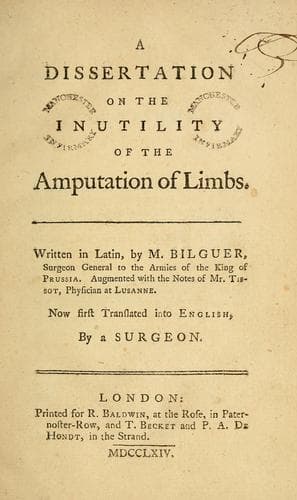
A dissertation on the inutility of the amputation of limbsBilguer, Johann Ulrich
History
A dissertation on the inutility of the amputation of limbs
Bilguer, Johann Ulrich
Amputation -- Early works to 1800
[49] I saw two patients who had each of them a troublesome caries, the
one on the tibia, the other on the external protuberance of the fibula;
their complaints, they told me, were of long standing, and that they
were cured by a travelling quack, the one in six weeks, the other in a
somewhat longer time. What I learned of the colour of the medicine, its
properties, and of its effects on the ailment, induced me to think it
was an acid spirit. This incident confirms what I was told by others,
and what Mr. Bilguer now remarks. TISSOT.
[50] I have seen several times, as well as Mr. Bilguer, the teeth
crumble away by degrees, after using the oil of cloves; I have seen the
same thing happen without the use either of it or of acids; I have, at
other times, employed it without any such effect, and although I am
convinced that it does hurt sometimes, it is only, I imagine, when the
caries is very considerable, and the tooth much wasted: This is not,
however, sufficient reason to give up, entirely, a medicine often very
serviceable in many cases of carious teeth. TISSOT.
[51] The indiscriminate use of viper broth is not proper at all times,
or in all cases of carious bones.
SECT. XXXIX.
It will certainly be asked, What must be done when the best
applications fail, and must we not amputate when the caries is very
extensive? I answer, that amputation is to no purpose if the caries be
attended with a bad habit of body, and while the morbid cause remains;
when this is removed, we ought not to despair of a cure, although
the greater part of the bone be carious, as the cases I have already
related plainly demonstrate[52]. We ought therefore to try other means,
and trepan the bone in several places, till whatever is rotten be
taken away. There are many bones, whereon amputation, even if it were
of use, is not practicable; if, for instance, the caries has attacked
the upper parts of the humeral, or thigh-bone, the jaw-bone, &c. The
method of treating the diseases of the bones, may be learned from the
cases of so many soldiers wounded at the articulations of the elbow,
knee, &c. and who, by the care bestowed on them in our hospitals, had
their limbs saved, notwithstanding they lost very large pieces of bone;
some of which were separated by nature, and some by the help of the
surgeon: And as no person will deny that the wounds made by a surgeon,
with an exceeding sharp instrument, and with much circumspection, in
order to remove the pieces of corrupted bone, are more easily cured
than wounds that are lacerated and contused, by means of a ball,
grape-shot, or splinters, &c. If the habit of body allows of any hope
of curing the caries, the method I have pointed out § XX. may also be
practiced in this case. It is true, the limb often remains deformed
after it, but this does not always happen; and frequently the callus
fills up the whole vacuity left by the part of the bone which is taken
out, however considerable it may have been. We read of successful
Public-domain text, read in full here on John Shaqi.
Reviews
Reviews
No reviews yet
Be the first to share your thoughts on this work.
Join the Discussion
Join the discussion
Sign in to leave a comment or review.
Sign InorCreate an account