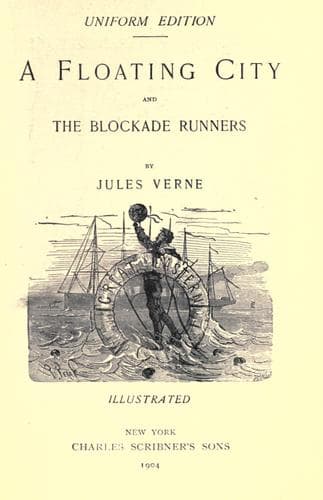
A Floating City, and The Blockade RunnersVerne, Jules
History
A Floating City, and The Blockade Runners
Verne, Jules
Great Eastern (Steamship) -- Fiction; United States -- History -- Civil War, 1861-1865 -- Blockades -- Fiction
The “St. John,” and its sister ship, the “Dean Richmond,” are two of the
finest steam-ships on the river. They are buildings rather than boats;
terraces rise one above another, with galleries and verandahs. One would
almost have thought it was a gardener’s floating plantation. There are
twenty flag-staffs, fastened with iron tressings, which consolidate the
whole building. The two enormous paddle-boxes are painted _al fresco_,
like the tympans in the Church of St. Mark, at Venice. Behind each wheel
rises the chimney of the two boilers, the latter placed outside, instead
of in the hull of the steam-ship, a good precaution in case of
explosion. In the centre, between the paddles, is the machinery, which
is very simple, consisting only of a single cylinder, a piston worked by
a long cross-beam, which rises and falls like the monstrous hammer of a
forge, and a single crank, communicating the movement to the axles of
the massive wheels.
Passengers were already crowding on to the deck of the “St. John.” Dean
Pitferge and I went to secure a cabin; we got one which opened into an
immense saloon, a kind of gallery with a vaulted ceiling, supported by a
succession of Corinthian pillars. Comfort and luxury everywhere,
carpets, sofas, ottomans, paintings, mirrors, even gas, made in a small
gasometer on board.
At this moment the gigantic engine trembled and began to work. I went on
to the upper terraces. At the stern was a gaily painted house, which was
the steersman’s room, where four strong men stood at the spokes of the
double rudder-wheel. After walking about for a few minutes, I went down
on to the deck, between the already heated boilers, from which light
blue flames were issuing. Of the Hudson I could see nothing. Night came,
and with it a fog thick enough to be cut. The “St. John” snorted in the
gloom like a true mastodon; we could hardly catch a glimpse of the
lights of the towns scattered along the banks of the river, or the
lanterns of ships ascending the dark water with shrill whistles.
At eight o’clock I went into the saloon. The Doctor took me to have
supper at a magnificent restaurant placed between the decks, where we
were served by an army of black waiters. Dean Pitferge informed me that
the number of passengers on board was more than four thousand, reckoning
fifteen hundred emigrants stowed away in the lower part of the
steam-ship. Supper finished, we retired to our comfortable cabin.
At eleven o’clock I was aroused by a slight shock. The “St. John” had
stopped. The captain, finding it impossible to proceed in the darkness,
had given orders to heave-to, and the enormous boat, moored in the
channel, slept tranquilly at anchor.
Public-domain text, read in full here on John Shaqi.
Reviews
Reviews
No reviews yet
Be the first to share your thoughts on this work.
Elsewhere in the archive
Join the Discussion
Join the discussion
Sign in to leave a comment or review.
Sign InorCreate an account