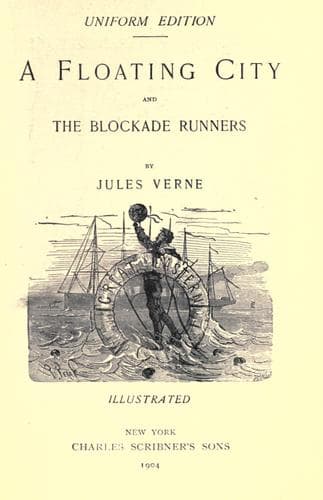
A Floating City, and The Blockade RunnersVerne, Jules
History
A Floating City, and The Blockade Runners
Verne, Jules
Great Eastern (Steamship) -- Fiction; United States -- History -- Civil War, 1861-1865 -- Blockades -- Fiction
At one o’clock, after having breakfasted, we went to the station, which
was without any barrier or officials. The train simply stopped in the
middle of the street, like an omnibus; one could get up and down at
pleasure. The cars communicate with each other by bridges, which allow
the traveller to go from one end of the train to the other. At the
appointed time, without seeing either a guard or a porter, without a
bell, without any warning, the brisk locomotive, a real gem of
workmanship, started, and we were whirled away at the speed of fifty
miles an hour. But instead of being boxed up, as one is in European
trains, we were at liberty to walk about, buy newspapers and books,
without waiting for stations. Refreshment buffets, bookstalls,
everything was at hand for the traveller. We were now crossing fields
without fences, and forests newly cleared, at the risk of a collision
with the felled trees; through new towns, seamed with rails, but still
wanting in houses; through cities adorned with the most poetic names of
ancient literature—Rome, Syracuse, and Palmyra. It was thus the Mohawk
Valley, the land of Fenimore, which belongs to the American novelist, as
does the land of Rob Roy to Walter Scott, glided before our eyes. For a
moment Lake Ontario, which Cooper has made the scene of action of his
master-work, sparkled on the horizon. All this theatre of the grand
epopee of Leather Stocking, formerly a savage country, is now a
civilized land. The Doctor did not appreciate the change, for he
persisted in calling me Hawk’s Eye, and would only answer to the name of
Chingachgook.
At eleven o’clock at night we changed trains at Rochester; the spray
from the Tennessee cascades fell over the cars in showers. At two
o’clock in the morning, after having kept alongside the Niagara for
several leagues without seeing it, we arrived at the village of Niagara
Falls, and the Doctor conducted me to a magnificent hotel, grandly named
“Cataract House.”
CHAPTER XXXVII.
The Niagara is not a stream, not even a river; it is simply a weir
sluice, a canal thirty-six miles long, which empties the waters of the
Lakes Superior, Michigan, Huron, and Erie into the Ontario. The
difference in the level of these last two lakes is three hundred and
forty feet; this difference uniformly proportioned the whole of the
width would hardly have created a “rapid;” but the Falls alone absorb
half the difference in level, whence their formidable power.
This Niagarine trench separates the United States from Canada. Its right
bank is American and its left English; on one side policemen, on the
other not the shadow of one.
Public-domain text, read in full here on John Shaqi.
Reviews
Reviews
No reviews yet
Be the first to share your thoughts on this work.
Elsewhere in the archive
Join the Discussion
Join the discussion
Sign in to leave a comment or review.
Sign InorCreate an account