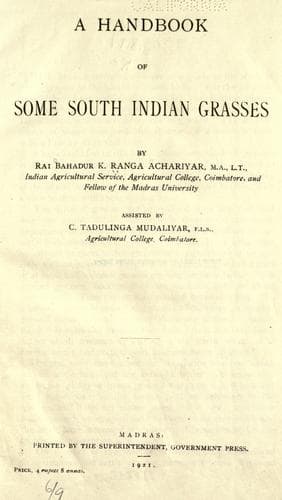
A Handbook of Some South Indian GrassesRangachari, K.
Science
A Handbook of Some South Indian Grasses
Rangachari, K.
Grasses -- India, South; Plants -- India, South
The _leaf-blade_ is lanceolate or narrowly lanceolate, base cordate and
subamplexicaul, glabrous or rarely sparsely hairy on both sides; margins
are wavy here and there, finely serrate with tubercle-based hairs
towards the base, the midrib is slender, not prominent and veins not
distinct. There is considerable variation in leaves especially in the
length. In the ordinary form it varies from 1/2 to 3 inches and even up
to 6 or 7 inches sometimes in length and the breadth from 1/8 to 1/4
inch. In one form which is separated as a variety (var. _brevifolium_,
Wight and Arnott,) the leaves are always short and broad,
ovate-lanceolate never exceeding 1 inch in length.
The _inflorescence_ consists of two or three, very rarely four erect or
spreading distant spikes on a somewhat slender very hairy peduncle.
_Spikes_ are from 1/2 to 2 inches; _rachis_ is slender, flexuous,
flattened, scaberulous, with a few long hairs scattered singly along the
margins or without these hairs.
[Illustration: Fig. 98.--Panicum distachyum.
1 and 2. Front and back view of a portion of a spike; 3, 4, 5, and 6.
the first, second, third and the fourth glume, respectively; 5a and 6a.
palea of the third and the fourth glume, respectively; 7. anthers and
ovary.]
The _spikelets_ are glabrous, ovate-oblong, acute, 1/8 inch, 1- or
2-seriate, subsessile, pale green, occasionally purplish on one side.
There are four _glumes_. The _first glume_ is membranous, broadly ovate,
obtuse with margins overlapping at the base, hardly half the length of
the third glume, usually 5-nerved but occasionally 7-nerved. The
attachment of the first glume is not close to that of the second glume
but is far lower. The _second glume_ is ovate-acute, 7-nerved. The
_third glume_ is equal to the second, 5-nerved, paleate, empty; the
_palea_ is narrow, hyaline, acute. The _fourth glume_ is ellipsoidal,
obtuse, chartaceous, minutely and obscurely rugulose, faintly 3-nerved,
with the base somewhat thickened. _Palea_ is similar to the glume in
texture. _Anthers_ are orange-yellow. _Lodicules_ are minute and fleshy.
Style branches are purple.
This grass is fairly common in open and loamy and sandy soils. The form
(var. _brevifolium_, Wight & Arnott) is fairly common in Coimbatore
District.
_Distribution._--Plains of India and Ceylon. Not recorded from the
Bombay Presidency. It occurs in China, Malaya and Australia.
[Illustration: Fig. 99.--Panicum interruptum.]
=Panicum interruptum, _Willd._=
This is a large perennial grass with stems reaching 5 to 6 feet in
length, flourishing in marshes and in the edges of ponds and tanks.
The stems are long, stout and spongy below, ascending from a creeping
and rooting or floating root-stock; the lower internodes are often 1/2
inch or more in thickness, with nodes bearing in fascicles long stout
roots clothed with fine lateral roots; and the upper internodes are long
and slender.
The _leaf-sheath_ is glabrous, striate. The _ligule_ is a short broad
membrane.
Public-domain text, read in full here on John Shaqi.
Reviews
Reviews
No reviews yet
Be the first to share your thoughts on this work.
Elsewhere in the archive
Join the Discussion
Join the discussion
Sign in to leave a comment or review.
Sign InorCreate an account