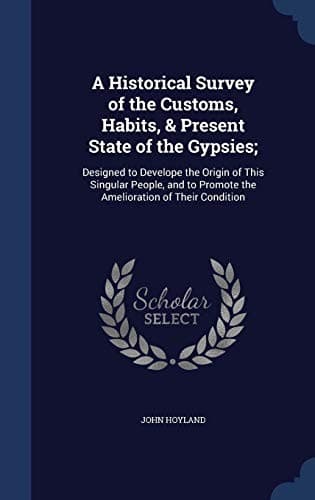
A Historical Survey of the Customs, Habits, & Present State of the GypsiesHoyland, John
History
A Historical Survey of the Customs, Habits, & Present State of the Gypsies
Hoyland, John
Romanies
The testimony of Bellonius is full and decisive on the point. He states;
“No part of the world, I believe, is free from those banditti, wandering
about in troops; whom we, by mistake, call Gypsies, and Bohemians. When
we were at Cairo, and the villages bordering on the Nile, we found troops
of these strolling thieves sitting under palm-trees; and they are
_esteemed foreigners_ in _Egypt_.”
Aventin expressly makes Turkey their original place of rendezvous; and
this furnishes a reason for the south east parts of Europe being the most
crowded with them. If all that came to Europe passed by this route, it
accounts for a greater number remaining in those countries, than in
others to which they would have a much longer travel; and before their
arrival at which, their hordes might be much divided.
It is a just assertion, that one of the most infallible methods of
determining the origin of a people, would be the discovery of a country
in which their language is that of the natives. It is a fact
incontrovertibly established, that besides the Gypsies speaking the
language of the country in which they live, they have a general one of
their own, in which they converse with each other.
Not knowing any speech correspondent with the Gypsies, some have been
ready to pronounce it a mere jargon; not considering how extravagant a
surmise it would be, that a people rude, uncivilized, and separated
hundreds of miles from each other, have invented a language. Others who
are better informed on the subject, allow that the language brought into
Europe with the Gypsies, was really vernacular, of some country; but
suppose it is so disguised and corrupted, partly by design, and partly by
adventitious events, through length of time, and the continued wandering
of these people, that it must be considered a new language, and now used
by the Gypsies only.
That it is the dialect of some particular part of the globe, though no
longer pure, as in the country whence it originated, is an opinion which
has obtained the greatest concurrence among the learned. Grellmann says,
had a German listened a whole day to a Gypsey conversation, he would not
have comprehended a single expression. It must doubtless appear
extraordinary, that the language of a people who had lived for centuries
in Europe, should have remained so much a secret: but it was not easy to
gain information from the Gypsies concerning it. Acquainted, by
tradition, with the deception their predecessors practised on coming into
Europe, they are suspicious; and fearing an explanation might be
dangerous to themselves, they are not disposed to be communicative.—But
how was it possible for the learned of former centuries, to be competent
to the investigation, who had not the aids which now so copiously occur
to the historical etymologist?
Public-domain text, read in full here on John Shaqi.
Reviews
Reviews
No reviews yet
Be the first to share your thoughts on this work.
Join the Discussion
Join the discussion
Sign in to leave a comment or review.
Sign InorCreate an account