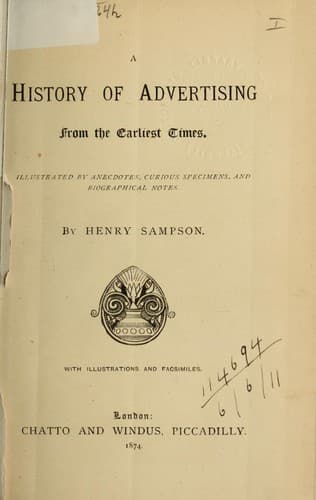
A History of Advertising from the Earliest Times.Sampson, Henry
History
A History of Advertising from the Earliest Times.
Sampson, Henry
Advertising -- History
The same story furnishes further particulars regarding the ancient mode
of crying. When Psyche has absconded, Venus requests Mercury “to
proclaim her in public, and announce a reward to him who shall find
her.” She further enjoins the divine crier to “clearly describe the
marks by which Psyche may be recognised, that no one may excuse himself
on the plea of ignorance, if he incurs the crime of unlawfully
concealing her.” So saying, she gives him a little book, in which is
written Psyche’s name and sundry particulars. Mercury thereupon descends
to the earth, and goes about among all nations, where he thus proclaims
the loss of Psyche, and the reward for her return:--“If any one can
seize her in her flight, and bring back a fugitive daughter of a king, a
handmaid of Venus, by name Psyche, or discover where she has concealed
herself, let such person repair to Mercury, the crier, behind the
boundaries of Murtia,[9] and receive by way of reward for the discovery
seven sweet kisses from Venus herself, and one exquisitely delicious
touch of her charming tongue.” A somewhat similar reward is offered by
Venus in the hue and cry she raises after her fugitive son in the first
idyl of Moschus, a Syracusan poet who flourished about 250 years before
the Christian era: “If any one has seen my son Eros straying in the
cross roads, [know ye] he is a runaway. The informer shall have a
reward. The kiss of Venus shall be your pay; and if you bring him, not
the bare kiss only, but, stranger, you shall have something more.”[10]
This something more is probably the “quidquid post oscula dulce” of
Secundus, but is sufficiently vague to be anything else, and certainly
promises much more than the “will be rewarded” of our own time.
So far with the Greeks and their advertisements. Details grow more
abundant when we enter upon the subject of advertising in Rome. The
cities of Herculaneum and Pompeii, buried in the midst of their sorrows
and pleasures, their joys and cares, in the very midst of the turmoil of
life and commerce, and discovered ages after exactly as they were on the
morning of that ominous 24th of August A.D. 79, show us that the benefit
to be derived from publicity was well understood in those luxurious and
highly-cultivated cities. The walls in the most frequented parts are
covered with notices of a different kind, painted in black or red. Their
spelling is very indifferent, and the painters who busied themselves
with this branch of the profession do not appear to have aimed at
anything like artistic uniformity or high finish. Still these
advertisements, hasty and transitory as they are, bear voluminous
testimony as to the state of society, the wants and requirements, and
the actual standard of public taste of the Romans in that age. As might
be expected, advertisements of plays and gladiators are common. Of these
the public were acquainted in the following forms,--
Public-domain text, read in full here on John Shaqi.
Reviews
Reviews
No reviews yet
Be the first to share your thoughts on this work.
Join the Discussion
Join the discussion
Sign in to leave a comment or review.
Sign InorCreate an account