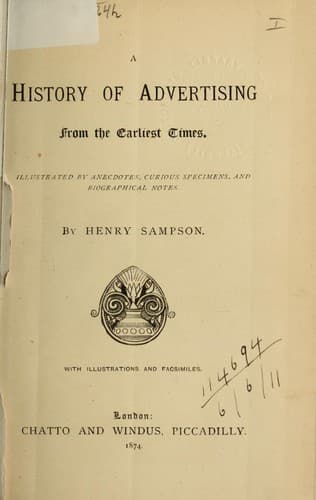
A History of Advertising from the Earliest Times.Sampson, Henry
History
A History of Advertising from the Earliest Times.
Sampson, Henry
Advertising -- History
The mediæval crier used to carry a horn, by means of which he attracted
the people’s attention when about to make a proclamation or publication.
Public criers appear to have formed a well-organised body in France as
early as the twelfth century; for by a charter of Louis VII., granted in
the year 1141 to the inhabitants of the province of Berry, the old
custom of the country was confirmed, according to which there were to be
only twelve criers, five of which should go about the taverns crying
with their usual cry, and carrying with them samples of the wine they
cried, in order that the people might taste. For the first time they
blew the horn they were entitled to a penny, and the same for every time
after, according to custom. These criers of wine were a French
peculiarity, of which we find no parallel in the history of England.
They perambulated the streets of Paris in troops, each with a large
wooden measure of wine in his hand, from which to make the passers-by
taste the wine they proclaimed, a mode of advertising which would be
very agreeable in the present day, but which would, we fancy, be rather
too successful for the advertiser. These wine-criers are mentioned by
John de Garlando, a Norman writer, who was probably a contemporary of
William the Conqueror. “Præcones vini,” says he, “clamant hiante gula,
vinum venumdandum in tabernis ad quatuor denarios.”[14] A quaint and
significant story is told in an old chronicle in connection with this
system of advertising. An old woman, named Adelheid, was possessed of a
strong desire to proclaim the Word of God, but not having lungs
sufficiently powerful for the noisy propagation contemplated by her, she
paid a wine-crier to go about the town, and, instead of proclaiming the
prices of the wine, to proclaim these sacred words: “God is righteous!
God is merciful! God is good and excellent!” And as the man went about
shouting these words she followed him, exclaiming, “He speaks well! he
says truly!” The poor old body hardly succeeded according to her pious
desire, for she was arrested and tried, and as it was thought she had
done this out of vanity (_causa laudis humanæ_), she was burned
alive.[15] From this it would seem that there was as much protection for
the monks in their profession as for the criers, who were very proud of
their special prerogatives.
The public criers in France, at an early period, were formed into a
corporation, and in 1258 obtained various statutes from Philip Augustus,
some of which, relating to the criers of wine, are excessively curious.
Thus it was ordained that--
“Whosoever is a crier in Paris may go to any tavern he likes and cry its
wine, provided they sell wine from the wood, and that there is no other
crier employed for that tavern; and the tavern-keeper cannot prohibit
him.
Public-domain text, read in full here on John Shaqi.
Reviews
Reviews
No reviews yet
Be the first to share your thoughts on this work.
Join the Discussion
Join the discussion
Sign in to leave a comment or review.
Sign InorCreate an account