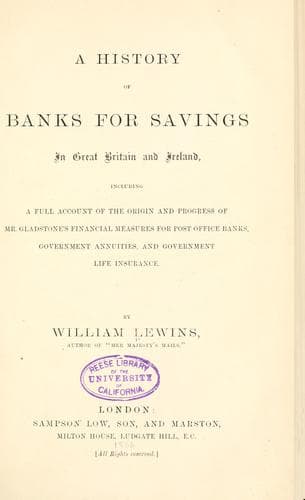
A History of Banks for Savings in Great Britain and IrelandLewins, William
History
A History of Banks for Savings in Great Britain and Ireland
Lewins, William
Postal savings banks -- Great Britain; Savings banks -- Great Britain
_Sir Joseph Yorke_ embraced the opportunity to compliment the
Chancellor, amidst great laughter, on being such a "valuable auxiliary
of the 'Great Untaught.' The right hon. gentleman evidently was not
one who spoke on the strength of two bottles of wine: his eloquence
was certainly not of a fiery description;" and more banter of the like
description. Mr. Lewis, however, withdrew his amendment, as did also
Mr. Hume, who, when the amount of interest which should be given was
discussed, had proposed that, in place of a reduction from 3_d._ to
2-1/2_d._ per diem, the interest on deposits should only be at the
rate of 2_d._ per diem. The bill was only further opposed in some
trifling particulars and, when finally carried, was ordered to come
into operation in the November of the same year. The statute was
entitled, "An Act to consolidate and amend the Laws relating to
Savings Banks," and repealed all other Acts previously in force. From
this circumstance, the clauses of the bill of 1828 are generally known
as the "Governing Statutes" relating to Savings Banks. As the great
majority of these clauses are still in force, it will suffice, when we
come to give the present Act, to simply mark those which were
originally passed in 1828, and so distinguish them from the clauses
passed in 1863. We will here give the principal items and arrangements
of the new bill. The Act provided that the rules of every Savings Bank
should be entered in a book, which book should be deposited with the
Clerk of the Peace: the Clerk of the Peace was directed to submit this
book to a barrister, who, under the terms of the Act, would be
appointed by the National Debt Commissioners.[39] The duty of the
barrister would be to certify that the Rules of the proposed bank were
strictly according to law, and this certification, after it had been
made, was to be laid before the Justices of the Peace in Quarter
Sessions, who were empowered under certain circumstances to reject the
same, or any part thereof. If admitted, as they most commonly would
be, after certification, the Rules became binding on depositors and
officers. The interest to be given to depositors, as we have already
stated, was reduced by this Act from 4_l._ 11_s._ 3_d._ per cent. per
annum, to 3_l._ 16_s._ 0-1/2_d._ per annum. It was provided that
savings of Minors might be invested, and that deposits might be made
by married Women. Charitable Societies were again authorized to invest
sums not exceeding 100_l._ per year, or 300_l._ in the whole. Friendly
Societies were also authorized to subscribe any portion of their funds
into Savings Banks, but a Friendly Society enrolled after the date of
the bill could not invest more than 300_l._ principal and interest
included. Trustees were not to receive from any one depositor more
than 30_l._ in any one year, nor more than 150_l._ in the whole and,
when the deposit and interest amounted to 200_l._ interest was to
cease.
Public-domain text, read in full here on John Shaqi.
Reviews
Reviews
No reviews yet
Be the first to share your thoughts on this work.
Join the Discussion
Join the discussion
Sign in to leave a comment or review.
Sign InorCreate an account