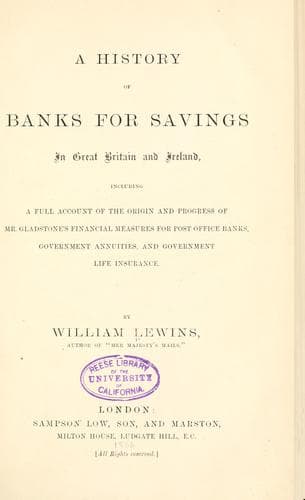
A History of Banks for Savings in Great Britain and IrelandLewins, William
History
A History of Banks for Savings in Great Britain and Ireland
Lewins, William
Postal savings banks -- Great Britain; Savings banks -- Great Britain
Depositors might withdraw their money and again subscribe,
providing they did not do it to a greater extent than 30_l._ in any
one year. Deposits might be withdrawn from one Savings Bank and placed
in another. Should a depositor die leaving any sum exceeding 50_l._
the same was not to be paid without probate or letters of
administration. Administration bonds for effects under 50_l._ were
exempt from stamp duty. Section nine exacted that no Trustee or
Manager should be responsible except for his own wilful neglect or
default; and finally, and a matter of considerable importance, the
bill provided that once in each year the Trustees of every Savings
Bank should make a Return to the National Debt Office, in which a full
Financial Statement should be made of the condition of the bank; and a
minor clause enacted that depositors should be entitled, on payment of
one penny, to a printed copy of this Annual Statement.
For several years after the thorough change which we have just
described, the institution of Savings Banks increased and prospered
wonderfully; up to the year 1833, we find that no steps were taken,
nor agitation of any sort got up, to alter the law with regard to
them. In this year, some further changes took place; but if we except
a slight modification which was made in the arrangements under which
depositors could withdraw their money,--a longer notice being thought
necessary,--nothing was done which did not place additional powers in
the hands of Trustees.
In April, 1833, Lord Althorp, Chancellor of the Exchequer in the
Government of Earl Grey, influenced, by a suggestion of Mr. Woodrow,
introduced a bill to grant immediate and deferred annuities through
the medium of Savings Banks, and to grant them on so small a scale as
to place them within reach of the humblest classes. Something of this
sort was undoubtedly required, and the necessity became more and more
felt on account of the action of Friendly Societies. The poorer
classes, it would seem, had scarcely any means of investing in
pensions for their old age: although nearly 5,000 Friendly Societies
had up to this time proposed to make some provision of the kind, all
but thirty-nine had in 1833 entirely relinquished this class of
business. It may be said that Friendly Societies gave up this business
because so few availed themselves of the provision that was made. From
the very constitution of these societies, however, the poor had little
confidence that any one of them would last so long as to give them
those benefits in their old age for which they would have to subscribe
for a long term of years. Benefit Societies might be broken up at any
time by two-thirds of their number; this sort of thing was constantly
occurring, generally leaving the oldest members in the lurch. An
attempt, to which we have not yet alluded, was made even before
Savings Banks were established, to give the industrial classes a
chance of providing for their old age, and preventing them from being
Public-domain text, read in full here on John Shaqi.
Reviews
Reviews
No reviews yet
Be the first to share your thoughts on this work.
Join the Discussion
Join the discussion
Sign in to leave a comment or review.
Sign InorCreate an account