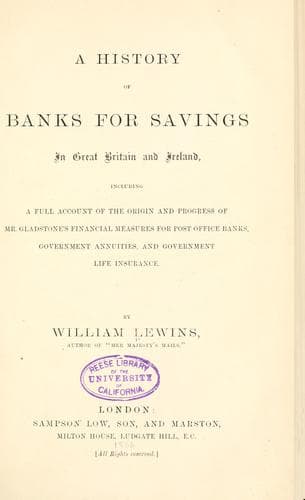
A History of Banks for Savings in Great Britain and IrelandLewins, William
History
A History of Banks for Savings in Great Britain and Ireland
Lewins, William
Postal savings banks -- Great Britain; Savings banks -- Great Britain
Nothing further was done in the way of legislation for Savings Banks
till 1844, so we will close this chapter by referring to another
attempt made by Mr. Hume, in 1838, to reduce the interest given to
Savings Banks, and to introduce other changes into their organization.
And here we cannot forbear to state our belief, that, though many
thought very differently at that time, Savings Banks, the working
classes, and the country generally, had not a better friend than Mr.
Joseph Hume. He saw a lavish expenditure going on in connexion with
Savings Banks, and he endeavoured to stop it; with what success
remains to be seen. He saw that in consequence of this expenditure, or
the inducements which it gave, legislative enactments were openly set
at defiance by well-to-do people, who, besides their own deposits,
made fraudulent investments in the names of the various members of
their families, or their friends; and that the action of the
Legislature was in this way an attempt to cultivate good habits
amongst one portion of the community, at the expense of promoting bad
habits amongst another. Mr. Hume on this occasion reminded the House
that he was one of the original founders of Saving Banks, and had
always taken a deep interest in them. It was far from him to do
anything to interfere with their usefulness in the country, only the
country ought not to be put to large and increasing expense over them.
He compared the rate of interest given before and after 1828, and now
stated that on this latter rate the country lost from ten shillings to
fifteen shillings per cent. on the entire amount of deposits. The
average annual loss to the public up to the time he was speaking, and
from 1818, had been 75,000_l._ If this money went to the provident
poor he would not so much care; but if all was paid to depositors,
that might not be the case. Of the 500 Savings Banks in existence in
1837, to whom the Commissioners paid 3_l._ 16_s._ 0-1/2_d._ per cent.
interest, 412 of them paid to the depositors only 3_l._ 6_s._ 8_d._,
and 88 of them paid 3_l._ 8_s._ leaving of course a large surplus,
after every expense had been paid, in the hands of both sets of
trustees. Hon. gentlemen might say that this surplus money was
required by law to be invested in the Surplus Fund account at the
National Debt Office; but the act, in leaving it to the trustees to
say what they themselves deemed "surplus," defeated its own ends, and
without doubt had opened a door to fraud. Mr. Hume made a motion that
the House at its rising should go into committee on the 9th Geo. IV.
c. 93, which fixes the rate of interest to be given, and to permit the
Chancellor of the Exchequer to reduce that rate to an equality with
that which is received in the public funds. He thoroughly believed
that the security afforded by Savings Banks was a matter of far
greater importance than the amount of interest which was paid. Mr.
Hume then referred to a subject which was made matter for great
Public-domain text, read in full here on John Shaqi.
Reviews
Reviews
No reviews yet
Be the first to share your thoughts on this work.
Join the Discussion
Join the discussion
Sign in to leave a comment or review.
Sign InorCreate an account