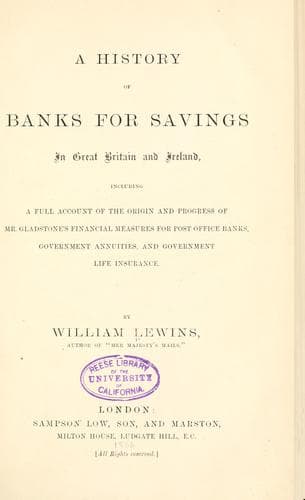
A History of Banks for Savings in Great Britain and IrelandLewins, William
History
A History of Banks for Savings in Great Britain and Ireland
Lewins, William
Postal savings banks -- Great Britain; Savings banks -- Great Britain
_The Chancellor of the Exchequer_, who at the time of which we are
speaking was Mr. Spring Rice (the late Lord Monteagle), was quite
unwilling to take the course recommended by Mr. Hume. He was sure it
would tend to shake the security of the deposits, to which the loss
which Mr. Hume had spoken of was a mere trifle. He admitted, however,
that if Parliament could have foreseen the extent to which Savings
Banks would so soon have arrived, wiser arrangements would undoubtedly
have been made. People certainly did not want all the inducements to
save their money which it was once thought they did require. Still, he
was not for changing the rate; Government paid more than they received
as interest, but he declined to argue the matter as a mere money
question. Mr. Hume might say that depositors cared more for security
than interest, but he (the Chancellor) said, that if they reduced that
interest, the depositors would rush to take out their money. Nor did
Mr. Rice speak without the book. He produced a paper in which was
described the effect of the various commercial and political panics on
Savings Banks, and in distinction to this the result of the reduction
of the rate of interest in 1828. So far as it went, the Return is
conclusive and instructing.[44] In the commercial panic of 1825, the
total amount withdrawn was 361,000_l._; in the political panic of
1832, 550,000_l._; in 1828, when the interest was reduced by 14_s._
per cent., no less a sum than 1,500,000_l._ was withdrawn. The
Chancellor would not say that under no possible circumstances should a
reduction take place; a time might come when it might be done wisely
and discreetly, though he believed it would never take place without
creating some degree of uncertainty and risk. The depositors in
Savings Banks were not the class to be experimented upon, and he would
not have it said of him by persons out of doors that he had commenced
reductions in the public expenditure by cutting down the interest
payable to the poorer classes, who, after all, he believed, were the
principal investors in Savings Banks. One other little item of
statistics Mr. Rice gave before he sat down, which is very
interesting, and much more convincing than his other arguments. He
gave, from a Return which we have not been able to find, the amount of
interest which had been paid _in money_ since the establishment of
Savings Banks and, on the other hand, the interest which had been
credited to depositors _and made into principal_. In the former case
it was 286,000_l._; in the latter, or interest made principal, it was
9,271,000_l._ Finally, the Chancellor believed, that to pay depositors
interest at the rate of the value of money in the market would be a
death-blow to Savings Banks altogether! If Mr. Hume, in his pursuit of
economy, tried to enforce it by dividing the House on the subject, his
duty would be to resist. _Mr. Goulburn_, as the spokesman of the
Public-domain text, read in full here on John Shaqi.
Reviews
Reviews
No reviews yet
Be the first to share your thoughts on this work.
Elsewhere in the archive
Join the Discussion
Join the discussion
Sign in to leave a comment or review.
Sign InorCreate an account