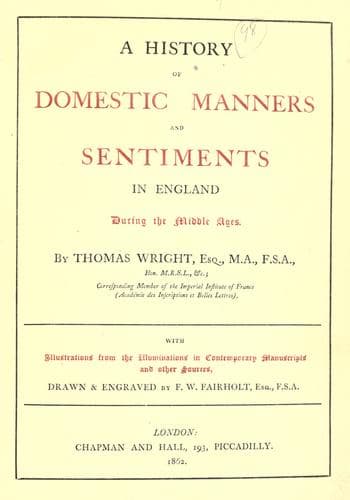
A History of Domestic Manners and Sentiments in England During the Middle AgesWright, Thomas
History
A History of Domestic Manners and Sentiments in England During the Middle Ages
Wright, Thomas
England -- Social life and customs -- 1066-1485
us that, when king Ethelred was a child, he once so irritated his
mother, that not having a whip, she beat him with some candles, which
were the first thing that fell under her hand, until he was almost
insensible. “On this account he dreaded candles during the rest of his
life, to such a degree that he would never suffer the light of them to
be introduced in his presence!”
[Illustration: _No. 37. Washing and Scourging._]
[Illustration: _No. 38. Hanging._]
The cruelty of the Anglo-Saxon ladies to their servants offers a
contrast to the generally mild character of the punishments inflicted
by the Anglo-Saxon laws. The laws of Ethelred contain the following
injunction, showing how contrary capital punishment is to the spirit of
Anglo-Saxon legislation:--“And the ordinance of our lord, and of his
witan (parliament), is, that Christian men for all too little be not
condemned to death; but in general let mild punishment be decreed, for
the people’s need; and let not for a little God’s handywork and his
own purchase be destroyed, which he dearly bought.” This injunction
is repeated in the laws of Canute. It appears that the usual method
of inflicting death upon criminals was by hanging. Our cut, No. 38,
taken from the illuminations to Alfric’s version of Genesis, represents
an Anglo-Saxon gallows (_galga_), and the rather primitive method of
carrying the last penalty of the law into effect. The early illuminated
manuscripts give us few representations of popular punishments.
The Anglo-Saxon vocabularies enumerate the following implements of
punishment, besides the _galga_, or gallows: fetters (_fæter_, _cops_),
distinguished into foot-fetters and hand-fetters; shackles (_scacul_,
or _sceacul_), which appear to have been used specially for the neck; a
_swipa_, or scourge; _ostig gyrd_, a knotted rod; _tindig_, explained
by the Latin _scorpio_, and meaning apparently a whip with knots or
plummets at the end of thongs, like those used by the charioteers in
the cuts in our next chapter; and an instrument of torture called a
_threpel_, which is explained by the Latin _equuleus_. The following
cut, No. 39, from the Harleian MS., No. 603 (so often quoted), shows
us the stocks, generally placed by the side of the public road at the
entrance to the town. Two other offenders are attached to the columns
of the public building, perhaps a court-house, by apparently a rope
and a chain. The Anglo-Saxon laws prescribe few corporal punishments,
but substitute for them the payment of fines, or compensation-money,
and these are proportioned to the offences with very extraordinary
minuteness. Thus, to select a few examples from the very numerous
list of injuries which may be done to a man’s person,--if any one
struck off an ear, he was to pay twelve shillings, and, if an eye,
fifty shillings; if the nose were cut through, the payment was nine
shillings. “For each of the four front teeth, six shillings; for
Public-domain text, read in full here on John Shaqi.
Reviews
Reviews
No reviews yet
Be the first to share your thoughts on this work.
Join the Discussion
Join the discussion
Sign in to leave a comment or review.
Sign InorCreate an account