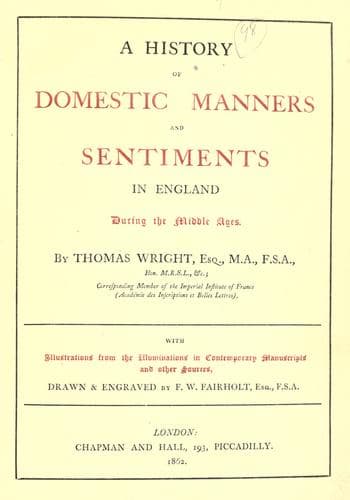
A History of Domestic Manners and Sentiments in England During the Middle AgesWright, Thomas
History
A History of Domestic Manners and Sentiments in England During the Middle Ages
Wright, Thomas
England -- Social life and customs -- 1066-1485
The deficiency of such comforts for travellers in Anglo-Saxon times was
compensated by the extensive practice of hospitality, a virtue which
was effectually inculcated by the customs of the people as well as by
the civil and ecclesiastical laws. When a stranger presented himself
at a Saxon door, and asked for board and lodging, the man who refused
them was looked upon with contempt by his countrymen. In the seventh
century, as we learn from the Pœnitentiale of archbishop Theodore,
the refusal to give lodging to a stranger (_quicunque hospitem non
receperit in domum suam_) was considered worthy of ecclesiastical
censure. And in the Ecclesiastical Institutes, drawn up at a later
period, and printed in the collection of Anglo-Saxon laws, it is stated
that “It is also very needful to every mass-priest, that he diligently
exhort and teach his parishioners that they be hospitable, and not
refuse their houses to any wayfaring man, but do for his comfort, for
love of God, what they then will or can; ... but let those who, for
love of God, receive every stranger, desire not any worldly reward.”
Bede describes as the first act of “the custom of hospitality” (_mos
hospitalitatis_) the washing of the stranger’s feet and hands; they
then offered him refreshment, and he was allowed to remain two nights
without being questioned, after which period the host became answerable
for his character. The ecclesiastical laws limited the hospitality to
be shown to a priest to one night, because if he remained longer it was
a proof that he was neglecting his duties.
Taverns of an ordinary description, where there was probably no
accommodation for travellers, seem to have been common enough under the
Anglo-Saxons and it must be confessed that there seems to be too much
reason for believing that people spent a great deal of their leisure
time in them; even the clergy appear to have been tempted to frequent
them. In the Ecclesiastical Institutes, quoted above, mass-priests are
forbidden to eat or drink at ale-houses (_æt ceap-ealothelum_). And it
is stated in the same curious record that, “It is a very bad custom
that many men practise, both on Sundays and also other mass-days; that
is, that straightways at early morn they desire to hear mass, and
immediately after the mass, from early morn the whole day over, in
drunkenness and feasting they minister to their belly, not to God.”
Public-domain text, read in full here on John Shaqi.
Reviews
Reviews
No reviews yet
Be the first to share your thoughts on this work.
Elsewhere in the archive
Join the Discussion
Join the discussion
Sign in to leave a comment or review.
Sign InorCreate an account