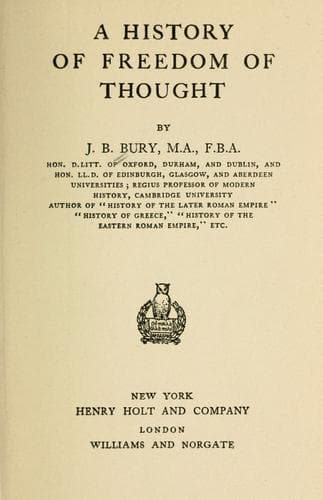
A History of Freedom of ThoughtBury, J. B. (John Bagnell)
Religion
A History of Freedom of Thought
Bury, J. B. (John Bagnell)
Free thought -- History; Rationalism -- History
[70] and underground unbelief here and there, which did not lead to any
serious consequences. The blasphemous statement that the world had been
deceived by three impostors, Moses, Jesus, and Mohammed, was current in
the thirteenth century. It was attributed to the freethinking Emperor
Frederick II (died 1250), who has been described as “the first modern
man.” The same idea, in a milder form, was expressed in the story of the
Three Rings, which is at least as old. A Mohammedan ruler, desiring to
extort money from a rich Jew, summoned him to his court and laid a snare
for him. “My friend,” he said, “I have often heard it reported that thou
art a very wise man. Tell me therefore which of the three religions,
that of the Jews, that of the Mohammedans, and that of the Christians,
thou believest to be the truest.” The Jew saw that a trap was laid for
him and answered as follows: “My lord, there was once a rich man who
among his treasures had a ring of such great value that he wished to
leave it as a perpetual heirloom to his successors. So he made a will
that whichever of his sons should be found in possession of this ring
after his death should be considered his heir. The son to whom he gave
the ring acted in the same way as his father, and so the ring passed
from hand to
[71] hand. At last it came into the possession of a man who had three
sons whom he loved equally. Unable to make up his mind to which of them
he should leave the ring, he promised it to each of them privately, and
then in order to satisfy them all caused a goldsmith to make two other
rings so closely resembling the true ring that he was unable to
distinguish them himself. On his death-bed he gave each of them a ring,
and each claimed to be his heir, but no one could prove his title
because the rings were indistinguishable, and the suit at law lasts till
this day. It is even so, my lord, with the three religions, given by God
to the three peoples. They each think they have the true religion, but
which of them really has it, is a question, like that of the rings,
still undecided.” This sceptical story became famous in the eighteenth
century, when the German poet, Lessing, built upon it his drama Nathan
the Sage, which was intended to show the unreasonableness of
intolerance.
CHAPTER IV
PROSPECT OF DELIVERANCE
(THE RENAISSANCE AND THE REFORMATION)
THE intellectual and social movement which was to dispel the darkness of
the
Public-domain text, read in full here on John Shaqi.
Reviews
Reviews
No reviews yet
Be the first to share your thoughts on this work.
Join the Discussion
Join the discussion
Sign in to leave a comment or review.
Sign InorCreate an account