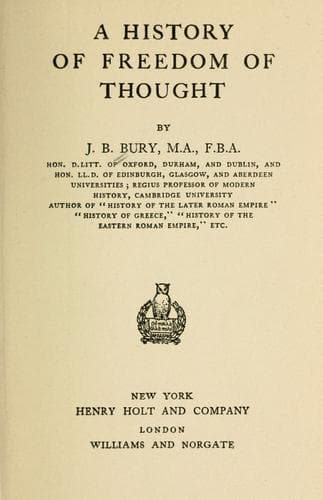
A History of Freedom of ThoughtBury, J. B. (John Bagnell)
Religion
A History of Freedom of Thought
Bury, J. B. (John Bagnell)
Free thought -- History; Rationalism -- History
But the triumph of freedom depended on other causes also; it was not to
be brought about by the intellect alone. The chief political facts of
the period were the decline of the power of the Pope in Europe, the
decay of the Holy Roman Empire, and the growth of strong monarchies, in
which worldly interests determined and dictated ecclesiastical policy,
and from which the modern State was to develop. The success of the
Reformation was made possible by these conditions. Its victory in North
Germany was due to the secular interest of the princes, who profited by
the confiscation of Church lands. In England there was no popular
movement; the change was carried through by the government for its own
purposes.
The principal cause of the Reformation was the general corruption of the
Church and the flagrancy of its oppression. For a long time the Papacy
had had no higher aim than to be a secular power exploiting its
spiritual authority for the purpose of promoting its worldly interests,
by which it was exclusively governed. All the European States based
their diplomacy on this assumption. Since the fourteenth century every
one acknowledged
[77] the need of reforming the Church, and reform had been promised, but
things went from bad to worse, and there was no resource but rebellion.
The rebellion led by Luther was the result not of a revolt of reason
against dogmas, but of widely spread anti-clerical feeling due to the
ecclesiastical methods of extorting money, particularly by the sale of
Indulgences, the most glaring abuse of the time. It was his study of the
theory of Papal Indulgences that led Luther on to his theological
heresies.
It is an elementary error, but one which is still shared by many people
who have read history superficially, that the Reformation established
religious liberty and the right of private judgment. What it did was to
bring about a new set of political and social conditions, under which
religious liberty could ultimately be secured, and, by virtue of its
inherent inconsistencies, to lead to results at which its leaders would
have shuddered. But nothing was further from the minds of the leading
Reformers than the toleration of doctrines differing from their own.
They replaced one authority by another. They set up the authority of the
Bible instead of that of the Church, but it was the Bible according to
Luther or the Bible according to Calvin. So far as the spirit of
intolerance went, there
[78] was nothing to choose between the new and the old Churches. The
religious wars were not for the cause of freedom, but for particular
sets of doctrines; and in France, if the Protestants had been
victorious, it is certain that they would not have given more liberal
terms to the Catholics than the Catholics gave to them.
Public-domain text, read in full here on John Shaqi.
Reviews
Reviews
No reviews yet
Be the first to share your thoughts on this work.
Join the Discussion
Join the discussion
Sign in to leave a comment or review.
Sign InorCreate an account