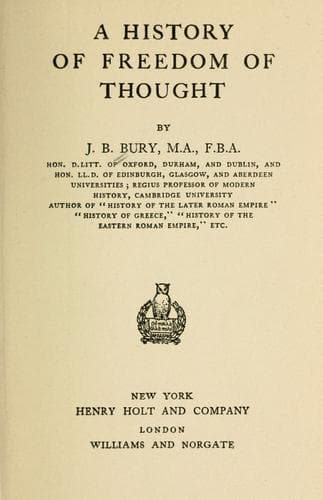
A History of Freedom of ThoughtBury, J. B. (John Bagnell)
Religion
A History of Freedom of Thought
Bury, J. B. (John Bagnell)
Free thought -- History; Rationalism -- History
Giordano Bruno had constructed a religious philosophy, based partly upon
Epicurus, from whom he took the theory of the infinity of the universe.
But Epicurean materialism was transformed into a pantheistic mysticism
by the doctrine that God is the soul of matter. Accepting the recent
discovery of Copernicus, which Catholics and Protestants alike rejected,
that the earth revolves round the sun, Bruno took the further step of
regarding the fixed stars as suns, each with its invisible satellites.
He sought to come to an understanding with the Bible, which (he held)
being intended for the vulgar had to accommodate itself to their
prejudices. Leaving Italy, because he was suspected of heresy, he lived
successively in Switzerland, France, England, and Germany, and in 1592,
induced by a false friend to return to Venice he was seized by order of
the Inquisition. Finally condemned in Rome, he was burned (1600) in the
Campo de’ Fiori, where a monument now stands in his honour, erected some
years ago, to the great chagrin of the Roman Church.
Much is made of the fate of Bruno because he is one of the world’s
famous men. No country has so illustrious a victim of that era to
commemorate as Italy, but in other lands
[85] blood just as innocent was shed for heterodox opinions. In France
there was rather more freedom than elsewhere under the relatively
tolerant government of Henry IV and of the Cardinals Richelieu and
Mazarin, till about 1660. But at Toulouse (1619) Lucilio Vanini, a
learned Italian who like Bruno wandered about Europe, was convicted as
an atheist and blasphemer; his tongue was torn out and he was burned.
Protestant England, under Elizabeth and James I, did not lag behind the
Roman Inquisition, but on account of the obscurity of the victims her
zeal for faith has been unduly forgotten. Yet, but for an accident, she
might have covered herself with the glory of having done to death a
heretic not less famous than Giordano Bruno. The poet Marlowe was
accused of atheism, but while the prosecution was hanging over him he
was killed in a sordid quarrel in a tavern (1593). Another dramatist
(Kyd) who was implicated in the charge was put to the torture. At the
same time Sir Walter Raleigh was prosecuted for unbelief but not
convicted. Others were not so fortunate. Three or four persons were
burned at Norwich in the reign of Elizabeth for unchristian doctrines,
among them Francis Kett who had been a Fellow of Corpus Christi,
Cambridge. Under James I, who
Public-domain text, read in full here on John Shaqi.
Reviews
Reviews
No reviews yet
Be the first to share your thoughts on this work.
Join the Discussion
Join the discussion
Sign in to leave a comment or review.
Sign InorCreate an account