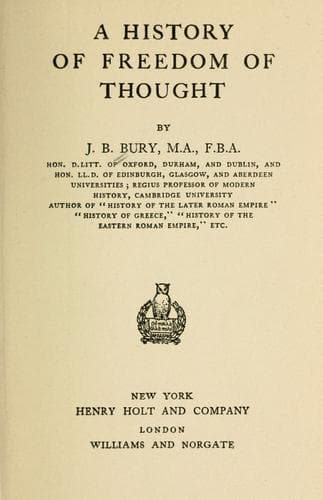
A History of Freedom of ThoughtBury, J. B. (John Bagnell)
Religion
A History of Freedom of Thought
Bury, J. B. (John Bagnell)
Free thought -- History; Rationalism -- History
In Europe, public opinion was not ripe for separation, inasmuch as the
most powerful religious bodies were alike in regarding toleration as
wicked indifference. But it was introduced in a small corner of the new
world beyond the Atlantic in the seventeenth century. The Puritans who
fled from the intolerance of the English Church and State and founded
colonies in New England, were themselves equally intolerant, not only to
Anglicans and Catholics, but to Baptists and Quakers. They set up
theocratical governments from which all who did not belong to their own
sect were excluded. Roger Williams had imbibed from the Dutch Arminians
the idea of separation of Church from State. On account of this heresy
he was driven from Massachusetts, and he founded Providence to be a
refuge for those whom the Puritan colonists persecuted. Here he set up a
democratic constitution in which the magistrates had power only in civil
matters and could not interfere with religion. Other towns were
presently founded in Rhode Island, and a charter of Charles II (1663)
confirmed the constitution, which secured to all citizens professing
Christianity, of whatever
[97] form, the full enjoyment of political rights. Non-Christians were
tolerated, but were not admitted to the political rights of Christians.
So far, the new State fell short of perfect liberty. But the fact that
Jews were soon admitted, notwithstanding, to full citizenship shows how
free the atmosphere was. To Roger Williams belongs the glory of having
founded the first modern State which was really tolerant and was based
on the principle of taking the control of religious matters entirely out
of the hands of the civil government.
Toleration was also established in the Roman Catholic colony of
Maryland, but in a different way. Through the influence of Lord
Baltimore an Act of Toleration was passed in 1649, notable as the first
decree, voted by a legal assembly, granting complete freedom to all
Christians. No one professing faith in Christ was to be molested in
regard to his religion. But the law was heavy on all outside this pale.
Any one who blasphemed God or attacked the Trinity or any member of the
Trinity was threatened by the penalty of death. The tolerance of
Maryland attracted so many Protestant settlers from Virginia that the
Protestants became a majority, and as soon as they won political
preponderance, they introduced an Act (1654)
[98] excluding Papists and Prelatists from toleration. The rule of the
Baltimores was restored after 1660, and the old religious freedom was
revived, but with the accession of William III the Protestants again
came into power and the toleration which the Catholics had instituted in
Maryland came to an end.
Public-domain text, read in full here on John Shaqi.
Reviews
Reviews
No reviews yet
Be the first to share your thoughts on this work.
Elsewhere in the archive
Join the Discussion
Join the discussion
Sign in to leave a comment or review.
Sign InorCreate an account