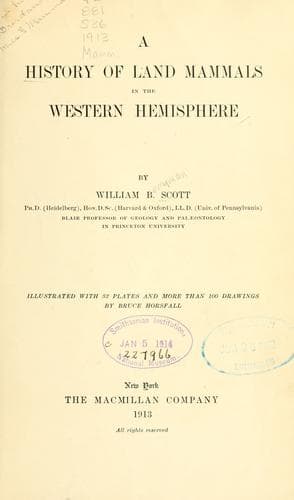
A history of land mammals in the western hemisphereScott, William Berryman
History
A history of land mammals in the western hemisphere
Scott, William Berryman
Mammals; Mammals, Fossil
It would, however, be misleading to claim a greater authority for these
attempts at restoring a long-vanished life than can fairly be ascribed
to them. The general form and proportions of the head, neck, body, tail,
limbs and feet may be deduced with a high degree of accuracy from the
skeleton, while the external characters of skin, hair and colouration
are largely conjectural, but not altogether imaginary. It cannot be
doubted that among the extinct mammals were many which, owing to some
uncommon growth of subcutaneous fat, or some unusual local development
of hair, were much more curious and bizarre in appearance than we can
venture to represent them. If, for example, the Camel, the Horse,
the Lion and the Right Whale were extinct and known only from their
skeletons, such restorations as we could make of them would assuredly go
astray in some particulars. The Camel would be pictured without his hump,
for there is nothing in the skeleton to suggest it; the forelock, mane
and characteristic tail of the Horse and the Lion’s mane would certainly
not be recognized; while the immense development of blubber in the head
of the Whale gives to it a very different appearance from that which the
skull would seem to indicate. Such cases are, however, exceptional and
restorations made by competent hands from complete skeletons probably
give a fair notion of the appearance of those animals when alive.
It will thus be sufficiently plain that the work of restoration is beset
with difficulties, but that there is no good ground for the uncritical
scepticism which summarily rejects the results as being purely fanciful,
or for the equally uncritical credulity which unhesitatingly accepts them
as fully and incontestably accurate. It is altogether likely that one
of the main sources of error consists in making the extinct animal too
closely resemble some existing species which is selected as a model.
Too much space has perhaps been devoted to the problem of restoring the
external form of these extinct mammals, a problem which, after all, is of
distinctly subordinate importance. The most valuable results which may be
gained from a study of these fossil mammals are the answers which they
afford to the great questions of relationship, classification and genetic
descent, and the light which they throw upon the processes of evolution
and the course of geographical arrangement. The bones and teeth afford
admirable means of tracing the gradual steps of modification by which the
modern mammals have arisen from very different ancestors and of following
their wanderings from region to region and continent to continent. It is
to these questions that most of the subsequent chapters are devoted.
CHAPTER III
THE CLASSIFICATION OF THE MAMMALIA
Public-domain text, read in full here on John Shaqi.
Reviews
Reviews
No reviews yet
Be the first to share your thoughts on this work.
Join the Discussion
Join the discussion
Sign in to leave a comment or review.
Sign InorCreate an account