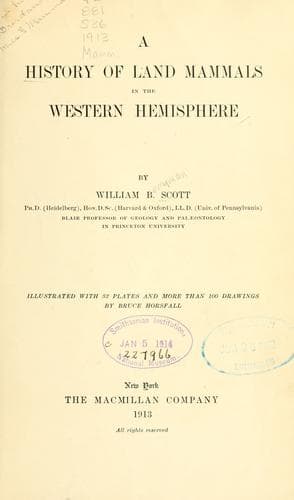
A history of land mammals in the western hemisphere — John Shaqi
A history of land mammals in the western hemisphereScott, William Berryman
History
A history of land mammals in the western hemisphere
Scott, William Berryman
Mammals; Mammals, Fossil
The terminology and nomenclature of science form a great barrier, which
only too often shuts out the educated layman from following the course
of investigation and keeping abreast of the discoveries in which he may
be particularly interested. No more frequent and heartfelt complaint
is uttered than that which decries the “scientific jargon,” and one
might be tempted to think that this jargon was a superfluous nuisance,
deliberately adopted to exclude the uninitiated and guard the secrets
of the temple from the curious intruder. As a matter of fact, however,
this terminology, though an unquestionable evil from one point of view,
is an indispensable implement of investigation and description. Ordinary
language has far too few words for the purpose and most of the words that
might be used lack the all-important quality of precision. The vernacular
names of animals and plants are notoriously inexact and, even when not
inaccurately employed, are not sufficiently refined and distinctive
for scientific use. This is pre-eminently true of the New World, where
the European settlers gave the names of the creatures with which they
had been familiar at home to the new animals which they found in the
western hemisphere. Some of these names, such as deer, wolf, fox, bear,
are accurate enough for ordinary purposes, while others are ludicrously
wrong. The bird that we call the Robin is altogether different from his
European namesake, and the great stag, or Wapiti, is commonly called
“Elk,” a name which properly belongs to the Moose. In short, it is
impossible to gain the necessary accuracy and abundance of vocabulary
without devising an artificial terminology, drawn chiefly from Greek and
Latin.
In dealing with fossils, the difficulty of nomenclature becomes
formidable indeed. The larger and more conspicuous mammals of the modern
world are more or less familiar to all educated people, and such names
as rhinoceros, hippopotamus, elephant, kangaroo, will call up a definite
and fairly accurate image of the animal in question. For the strange
creatures that vanished from the earth ages before the appearance of Man
_there are no vernacular names_ and it serves no good purpose to coin
such terms. To the layman names like _Uintatherium_ or _Smilodon_ convey
no idea whatever, and all that can be done is to attempt to give them a
meaning by illustration and description, using the name merely as a peg
upon which to hang the description.
Public-domain text, read in full here on John Shaqi.
Reviews
Reviews
No reviews yet
Be the first to share your thoughts on this work.
Join the Discussion
Join the discussion
Sign in to leave a comment or review.
Sign InorCreate an account