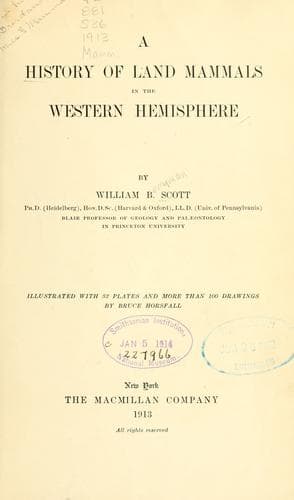
A history of land mammals in the western hemisphereScott, William Berryman
History
A history of land mammals in the western hemisphere
Scott, William Berryman
Mammals; Mammals, Fossil
A word should be said as to the conventions of printing technical names.
The names of all species are, in American practice, printed in small
letters, but many Europeans write specific terms which are proper nouns
or adjectives with a capital. Generic, family and all groups of higher
rank are always written with a capital, unless used in vernacular form,
_e.g._ Artiodactyla and artiodactyls. It is also a very general custom to
give capitals to vernacular names of species, as the Mammoth, the Coyote,
the Black Bear. Genus and species are almost invariably in italics,
groups of higher rank in roman.
Such a scheme of classification as is outlined above has a decidedly
artificial air about it and yet it serves a highly useful purpose in
enabling us to express in brief and condensed form what is known or
surmised as to the mutual relationships of the great and diversified
assemblage of mammals. The scheme has been compared to the organization
of an army into company, battalion, regiment, brigade, division,
army corps, etc., and there is a certain obvious likeness; but the
differences go deeper, for an army is an assemblage of similar units,
mechanically grouped into bodies of equal size. A much closer analogy
is the genealogical or family tree, which graphically expresses the
relationships and ramifications of an ancient and widespread family,
though even this analogy may easily be pushed too far. Blood-relationship
is, in short, the underlying principle of all schemes of classification
which postulate the theory of evolution.
Public-domain text, read in full here on John Shaqi.
Reviews
Reviews
No reviews yet
Be the first to share your thoughts on this work.
Join the Discussion
Join the discussion
Sign in to leave a comment or review.
Sign InorCreate an account