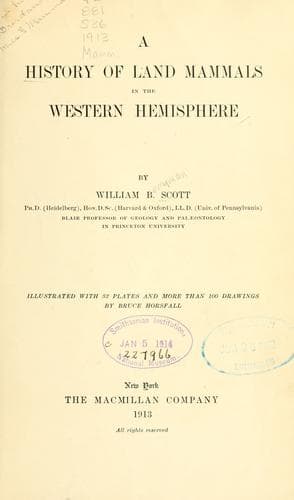
A history of land mammals in the western hemisphereScott, William Berryman
History
A history of land mammals in the western hemisphere
Scott, William Berryman
Mammals; Mammals, Fossil
The vast assemblage of placental mammals, which range over all the
continents, are divided into numerous orders, most of which appear to be
natural groups of truly related forms, while some are but doubtfully so
and others again are clearly unnatural and arbitrary. As has already been
pointed out, the mutual relationships of these orders, as expressed in
groups of higher than ordinal rank, offer a much more difficult problem,
chiefly because our knowledge of the history of mammals is most deficient
just where that history is most important and significant, namely, in its
earlier portion. In many instances, the evolution of genera and families
may be followed out within the limits of the order in a very convincing
way, but very rarely can the origin of an order be demonstrated. When the
history began to be full and detailed, the orders had nearly all been
established, and, until the steps of their divergence and differentiation
can be followed out, their mutual relationships can be discussed only
from the standpoint of their likenesses and differences. In the valuation
of these, there is much room for difference of opinion, and such
difference is not lacking. On the other hand, concerning the number and
limits of the orders themselves there is very general agreement.
In the following table only the major groups are included and those which
are extinct are marked with a dagger (†). The scheme is almost identical
with that given in Professor Osborn’s “Age of Mammals,” the few points
in which I should prefer a somewhat different arrangement being waived
in the interests of uniformity and avoidance of confusion. A few changes
are, however, made in matters which I regard as too important to ignore.
Public-domain text, read in full here on John Shaqi.
Reviews
Reviews
No reviews yet
Be the first to share your thoughts on this work.
Elsewhere in the archive
Join the Discussion
Join the discussion
Sign in to leave a comment or review.
Sign InorCreate an account